---
title: Why There's No Mystery To How the Moai were Built
description: the truth behind the building of the moai
image: https://blog.nayararesorts.com/hubfs/Moai-1.jpg
---
[Blog](https://blog.nayararesorts.com/)
[](https://nayararesorts.com/)
SUBSCRIBE

# Why There's No Mystery To How the Moai were Built
[Albert Ghitis](https://blog.nayararesorts.com/author/albert-ghitis-1)
Oct 8, 2026
For generations, the question of how Rapa Nui moved its colossal moai inspired theories involving timber rollers, enormous workforces and ecological destruction. Archaeology now points toward something more ingenious: many of the statues may have been engineered to move upright, rocking forward in a controlled motion that matches the island's own tradition that the moai "walked."
Key Findings
900+
Moai survive across Rapa Nui, alongside more than 300 ceremonial platforms and a landscape of quarries, roads and settlements.
18 people
Moved a 4.35-ton experimental moai 100 meters in 40 minutes using the latest vertical "walking" transport test.
16–18 km
The distance some moai were transported from the quarry across one of the world's most isolated inhabited islands.
In This Article
7 min read
[01 More Than Stone Giants](https://blog.nayararesorts.com/why-theres-no-mystery-to-how-the-moai-were-built#ancestors) [02 How the Moai Were Carved](https://blog.nayararesorts.com/why-theres-no-mystery-to-how-the-moai-were-built#quarry) [03 Did the Moai Walk?](https://blog.nayararesorts.com/why-theres-no-mystery-to-how-the-moai-were-built#walking) [04 What the Roads Reveal](https://blog.nayararesorts.com/why-theres-no-mystery-to-how-the-moai-were-built#roads) [05 The Pukao Problem](https://blog.nayararesorts.com/why-theres-no-mystery-to-how-the-moai-were-built#pukao) [06 Why the Moai Still Matter](https://blog.nayararesorts.com/why-theres-no-mystery-to-how-the-moai-were-built#meaning) [07 The Rapa Nui Collection](https://blog.nayararesorts.com/why-theres-no-mystery-to-how-the-moai-were-built#series) [08 Frequently Asked Questions](https://blog.nayararesorts.com/why-theres-no-mystery-to-how-the-moai-were-built#faq)
The Moai
## More Than Stone Giants
**In short:** Rapa Nui's moai were monumental representations connected to ancestors, lineage and ceremonial landscapes. Most were carved at Rano Raraku and moved across the island to ahu, or ceremonial platforms. Recent archaeology provides strong evidence that many may have been transported vertically, rocking from side to side in a controlled motion that made them appear to walk.
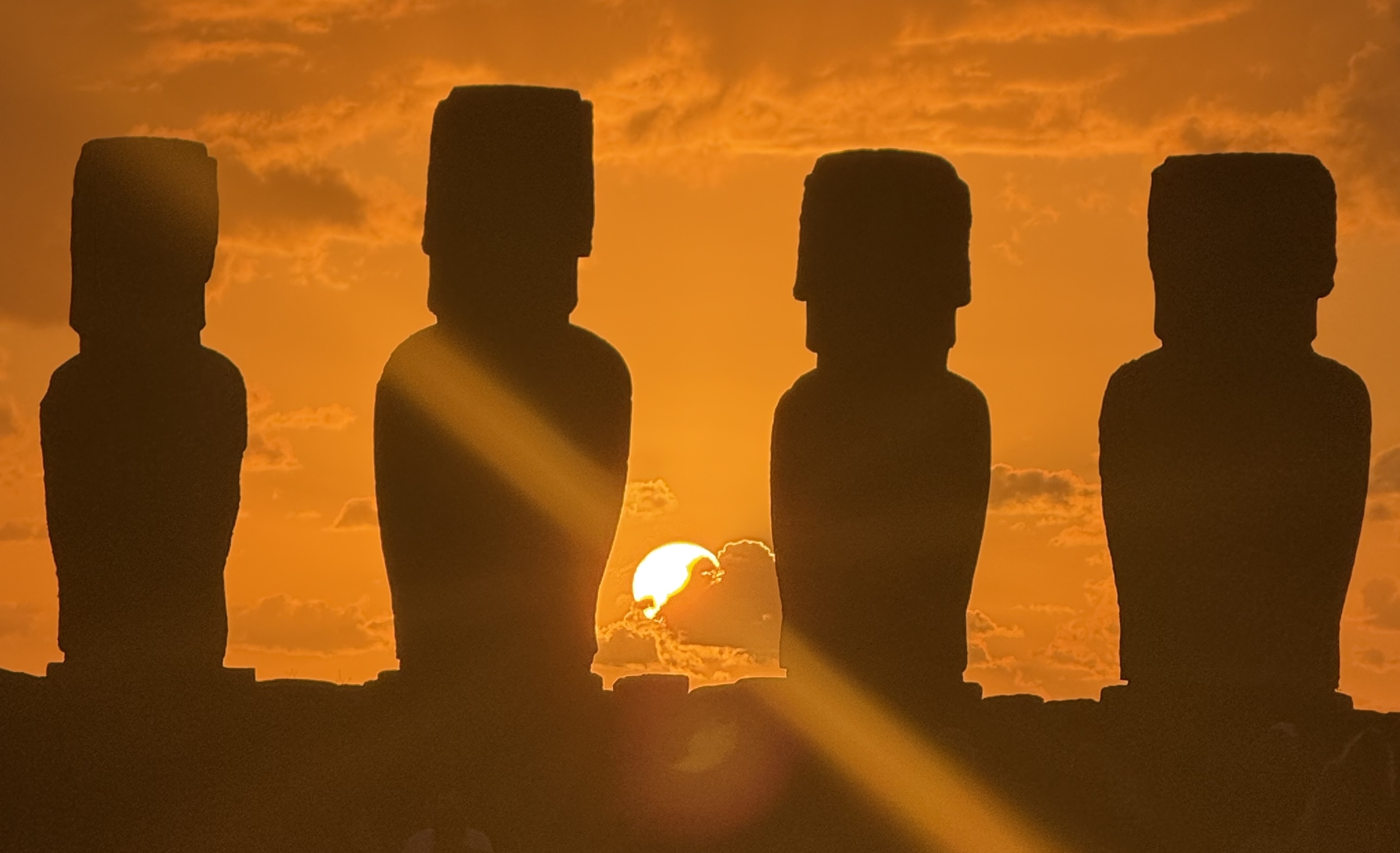
To the outside world, the moai became the image of Rapa Nui. Their silhouettes are instantly recognizable. Their meaning is less easily reduced.
UNESCO describes the island's monumental sculpture as one of the defining expressions of Rapa Nui culture. More than 900 statues survive across the island, along with hundreds of ceremonial platforms and thousands of structures related to settlement, agriculture and ritual life.
The moai are generally understood as representations connected to revered ancestors. They were not isolated sculptures intended to be viewed in museums. They belonged to ahu, communities, landscapes and systems of lineage. Their power came from relationship.
That context matters because one of archaeology's most famous engineering questions, how people moved statues weighing many tons across a treeless volcanic island, is not merely a puzzle about stone. It is a question about organization, knowledge and what communities were capable of building together.
Rano Raraku
## How the Moai Were Carved
Most moai were carved from volcanic tuff at Rano Raraku, the great quarry on the eastern side of the island. The quarry remains one of archaeology's clearest records of monumental production because statues survive at almost every stage of manufacture.
Carvers worked directly into the exposed rock using basalt tools known as toki. The front and sides of a statue were shaped while it remained attached to the bedrock. The final connection along the back could then be cut, allowing the statue to be lowered from the quarry face and prepared for transport.
Unfinished figures still lie within the quarry. Others stand partly buried on its slopes. Their different stages of completion preserve an extraordinary archaeological sequence: conception, carving, release, finishing and departure.
The quarry therefore answers one question while creating another. The Rapa Nui could carve monumental stone with remarkable precision. How they then moved it across kilometers of uneven volcanic terrain became the mystery that dominated the next century of archaeological debate.
The Experiment
## Did the Moai Walk?
For decades, explanations for moai transport often began with timber. Statues were imagined lying horizontally on sledges or rollers, dragged by large workforces over wooden infrastructure. The theory fit neatly into another popular story: that statue building consumed the island's forests and contributed to ecological collapse.
But road statues create a problem for that model. Many have a pronounced forward lean, wide bases and shapes that differ systematically from statues already standing on ceremonial platforms.
In 2013, archaeologists Carl Lipo, Terry Hunt and Sergio Rapu Haoa tested an alternative explanation. Using a precisely scaled 4.35-ton replica, teams positioned on either side used ropes to rock the upright statue from side to side while a third rope stabilized the movement from behind. The statue advanced forward.
A major 2025 reassessment strengthened the case. Lipo and Hunt examined 962 moai, including 62 statues abandoned along transport roads, and combined statue morphology, road geometry, breakage patterns and experimental evidence. In their latest experiment, 18 people moved the replica 100 meters in roughly 40 minutes.
The remarkable part is not that archaeologists made a stone statue move. It is that the engineering evidence converges with Rapa Nui oral tradition. The moai were said to have walked.
The most compelling modern explanation is also the one preserved in Rapa Nui memory: the moai walked.
The Evidence
## What the Roads Reveal
Experimental archaeology matters only when the experiment explains the archaeological record. That is where the walking hypothesis becomes stronger.
Ancient statue roads extend outward from Rano Raraku toward ceremonial centers across the island. Researchers have identified statues abandoned along those routes, many with physical features consistent with upright transport rather than horizontal dragging.
Their distribution is also revealing. The 2025 analysis found that more than half of the road statues examined were concentrated within two kilometers of the quarry, a pattern consistent with transport failures becoming less frequent as successfully moved statues traveled farther from their origin.
The roads themselves contribute another clue. Their broad, often concave profiles fit a system in which an upright statue could be rocked from side to side while teams controlled its balance with ropes.
None of this means archaeology has closed every question about every statue. Different periods, statue forms and destinations may have involved variation. But the evidence increasingly makes one point difficult to dismiss: moving the moai did not require the enormous timber infrastructure once assumed.
Above the Moai
## The Pukao Problem
Moving the statues was not the end of the engineering problem. Some moai received massive red-scoria cylinders known as pukao, quarried separately at Puna Pau.
These multi-ton forms had to be transported across the island and then raised to the tops of already standing statues. A 2018 study used three-dimensional models of 50 pukao and quarry examples to reconstruct the process.
The researchers concluded that relatively small groups could have rolled the pukao up stone ramps using a parbuckling technique, in which ropes wrapped around the cylinder multiply mechanical advantage as it rolls upward.
Again, the archaeological lesson is not one of brute force. It is one of mechanical understanding. Monumental scale did not necessarily require monumental populations. Rapa Nui engineering repeatedly solved large problems with controlled movement, geometry and collective coordination.
Living Heritage
## Why the Moai Still Matter
The danger in turning the moai into an engineering mystery is that the mystery begins to eclipse the people who created them.
Rapa Nui is not an abandoned archaeological site. It is a living community whose relationship with these monuments continues. The knowledge surrounding stone carving, ancestry, land and ceremonial places belongs within that living cultural landscape.
That continuity also makes conservation urgent. In October 2022, wildfire affected Rano Raraku and damaged archaeological resources, including moai. UNESCO's subsequent assessment identified significant alterations requiring intervention and called for expanded risk management and conservation planning.
The question facing Rapa Nui today is therefore different from the one outsiders have asked for generations. It is no longer simply: how did they move the statues?
It is: how do you protect a cultural landscape whose global fame brings the very pressure that threatens it?
At [Nayara Hangaroa](https://nayarahangaroa.com/), the moai are encountered not as isolated icons but within an island still shaped by Rapa Nui families, guides, artists and cultural stewards. That is the context in which they make the most sense.
Explore the Collection
## The Rapa Nui Collection
Go deeper into Rapa Nui through archaeology, cultural survival, regeneration, living traditions and the engineering behind the moai.
[01 A Collapse That Wasn't: What the Maya and Rapa Nui Teach Us →](https://blog.nayararesorts.com/a-collapse-that-wasnt-a-collapse) [02 How Nayara Hangaroa Leads Regeneration on Rapa Nui →](https://blog.nayararesorts.com/walking-giants-the-hito-family-the-future-of-easter-island) [03 What Is Tapati Rapa Nui and Why It Matters →](https://blog.nayararesorts.com/the-tapati-rapa-nui-festival-at-nayara-hangaroa)
04 How the Moai Moved: What Archaeology Now Says About Rapa Nui's Stone Giants You're Here
Nayara Hangaroa
## Stand Before the Moai Yourself
Experience Rapa Nui through its archaeology, living culture and landscapes from Nayara Hangaroa.
[Explore Nayara Hangaroa](https://nayarahangaroa.com/) [Check Availability](https://nayararesorts.com/#/booking/destination/dates) [Explore the Nayara Collection](https://nayararesorts.com/our-resorts/)
About the Author
## [Albert Ghitis](https://blog.nayararesorts.com/author/albert-ghitis-1)
Digital Marketing · Nayara Resorts
Albert Ghitis leads digital marketing at Nayara Resorts, overseeing editorial, email strategy, organic social, paid social, search, and AI discovery. He also hosts Nayara Horizons. Explore the latest episodes below.
Nayara Horizons
## Explore the Podcast
Conversations about the people, places, cultures and ideas behind Nayara's destinations.
01
Understanding the Atacama: A Conversation with the Atacameño Community
[Watch →](https://youtu.be/kzQWMUk49io?si=F6mKVna2uN0pO7gA)
02
Guardians of Rapa Nui: A Conversation with Tau Mana
[Watch →](https://youtu.be/FRPVRcUTNmk?si=2SrY7mElfqprkyJg)
03
The Collapse That Wasn't: A Conversation About Archaeology
[Watch →](https://youtu.be/qFVLTTJa7hE?si=LU3lrWxrFGbL6gpF)
04
The Nayara Story: A Conversation with General Manager Jairo
[Watch →](https://youtu.be/kogGcI2-pBc?si=JI-a82zE1nZODNfl)
05
A Taste of Nayara: A Conversation with Gianluca
[Watch →](https://youtu.be/NuWOobuMc2k?si=g7uHgszKtOhiMekv)
Frequently Asked Questions
## The Moai of Rapa Nui
How many moai are on Rapa Nui?+
UNESCO estimates that about 900 moai survive on Rapa Nui, along with more than 300 ceremonial platforms and thousands of other archaeological structures.
Where were the moai carved?+
Most were carved from volcanic tuff at Rano Raraku, where unfinished statues and figures at different stages of production still preserve evidence of the carving process.
Did the moai really walk?+
The strongest current archaeological model argues that many moai were transported upright using ropes to rock them from side to side in a controlled forward motion. Experimental tests and the morphology of statues abandoned along ancient roads support this "walking" hypothesis.
Did moving the moai require cutting down the island's forests?+
The vertical transport model does not require timber rollers or large wooden sleds. That weakens older arguments that moai transport itself necessarily drove catastrophic deforestation.
What are the red forms on top of some moai?+
They are known as pukao and were carved from red scoria at Puna Pau. Archaeological modeling suggests they could have been rolled up ramps and raised onto standing moai using relatively small workforces.
Can visitors see the moai from Nayara Hangaroa?+
Yes. Nayara Hangaroa serves as a base for guided exploration of Rapa Nui's archaeological landscape, including major moai sites and Rano Raraku, within the island's current visitor and conservation rules.
Sources & Further Reading
- [UNESCO World Heritage · Rapa Nui National Park](https://whc.unesco.org/en/list/715)
- [Lipo & Hunt · The Walking Moai Hypothesis, Journal of Archaeological Science, 2025](https://www.sciencedirect.com/science/article/pii/S0305440325002328)
- [Lipo, Hunt & Rapu Haoa · The Walking Megalithic Statues of Easter Island](https://www.sciencedirect.com/science/article/pii/S0305440312004311)
- [Hixon et al. · Pukao Transport and Emplacement, Journal of Archaeological Science](https://www.sciencedirect.com/science/article/pii/S030544031830195X)
- [UNESCO · Conservation Assessment After the 2022 Rano Raraku Fire](https://whc.unesco.org/en/news/2587)
- [Easter Island Statue Project](https://www.eisp.org/)
- [Museo Antropológico Padre Sebastián Englert](https://www.museorapanui.gob.cl/)
- [Nayara Hangaroa · Rapa Nui](https://nayarahangaroa.com/)
[.jpg)](https://blog.nayararesorts.com/the-tapati-rapa-nui-festival-at-nayara-hangaroa)
## [What Is Tapati Rapa Nui and Why It Matters](https://blog.nayararesorts.com/the-tapati-rapa-nui-festival-at-nayara-hangaroa)
Jan 24, 2025
[](https://blog.nayararesorts.com/which-nayara-is-right-for-you)
## [Which Nayara is Right for You?](https://blog.nayararesorts.com/which-nayara-is-right-for-you)
Aug 25, 2026
[](https://blog.nayararesorts.com/a-collapse-that-wasnt-a-collapse)
## [A Collapse That Wasn’t: What the Maya and Rapa Nui Teach Us About Climate and Survival](https://blog.nayararesorts.com/a-collapse-that-wasnt-a-collapse)
Jan 31, 2026
- [Nayara Gardens](https://nayaragardens.com/)
- [Nayara Springs](https://nayarasprings.com/)
- [Nayara Tented Camp](https://nayaratentedcamp.com/)
- [Nayara Alto Atacama](https://www.altoatacama.com/)
- [Nayara Hangaroa](https://www.hangaroa.cl/)
- [Nayara Bocas Del Toro](https://bocasbali.com/)
-
-
-
-
-
-
- [Costa Rica +506 2479-1600](tel:+50624791600)
- [US +1 844-865-2002](tel:+18883322961)
- [UK +44 1617918120](tel:+441617918120)
```json
{
"@context" : "https://schema.org",
"@type" : "BlogPosting",
"author" : {
"@type" : "Person",
"name" : "Albert Ghitis",
"url" : "https://blog.nayararesorts.com/author/albert-ghitis-1"
},
"dateModified" : "2026-10-08T23:15:50.444Z",
"datePublished" : "2026-10-08T23:14:31.000Z",
"headline" : "Why There's No Mystery To How the Moai were Built",
"image" : [ "https://blog.nayararesorts.com/hubfs/Moai-1.jpg" ],
"mainEntityOfPage" : {
"@id" : "https://blog.nayararesorts.com/why-theres-no-mystery-to-how-the-moai-were-built",
"@type" : "WebPage"
},
"publisher" : {
"@type" : "Organization",
"logo" : {
"@type" : "ImageObject",
"url" : "https://blog.nayararesorts.com/hubfs/Captura%20de%20pantalla%202023-04-13%20a%20la(s)%2010.55.13.png"
},
"name" : "Nayara Resorts"
}
}
```