---
title: "The Atacama Desert: At the Edge of Habitability"
description: "Understanding the Atacama Desert: Landscape, Climate, and Extremes | Nayara Alto Atacama"
image: https://blog.nayararesorts.com/hubfs/5-Jan-28-2026-12-18-54-4709-AM.png
---
[Blog](https://blog.nayararesorts.com/)
[](https://nayararesorts.com/)
SUBSCRIBE
# The Atacama Desert: At the Edge of Habitability
[Albert Ghitis](https://blog.nayararesorts.com/author/albert-ghitis-1)
Jan 8, 2024
Key Findings
10–15M yrs
How long parts of the Atacama have stayed hyper-arid, making it the oldest and most stable non-polar desert on Earth.
2,400m+
Elevation across much of the region, placing observers above a large share of the atmosphere and producing some of the clearest skies on Earth.
3 species
Andean, Chilean, and James's flamingos feed in hypersaline lagoons at the heart of the driest desert, indicators of a fragile chemical balance.
The Oasis
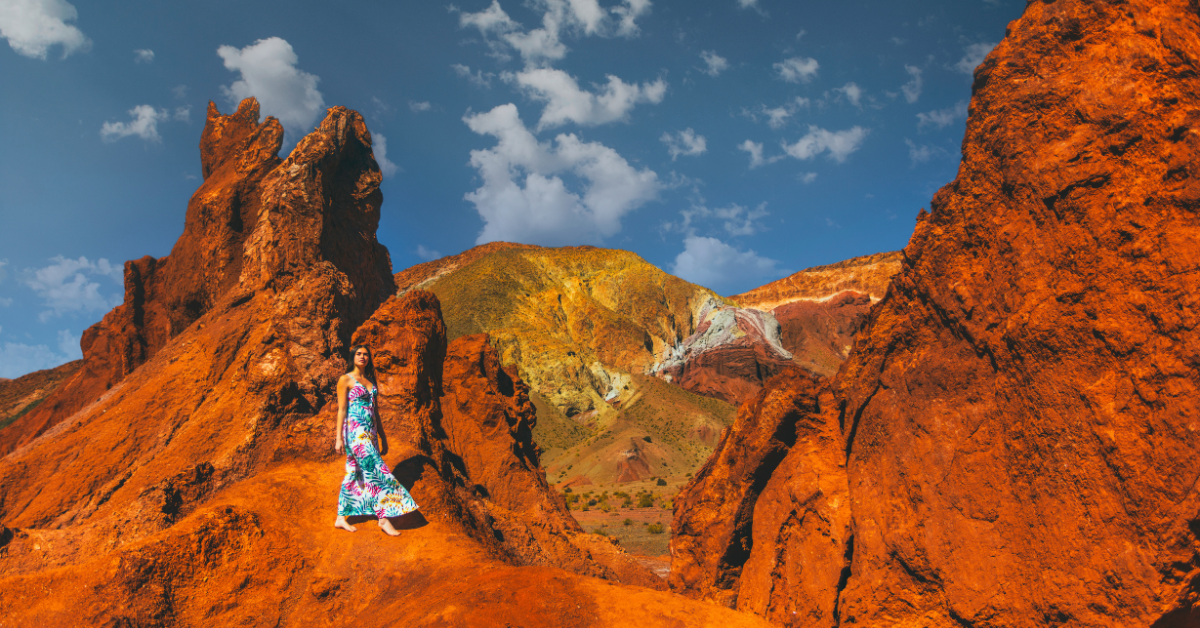
At the edge of the Catarpe Valley, where red rock walls narrow and the desert briefly reorganizes itself around scarce water and shelter, humans can appear.
This is where [Nayara Alto Atacama](https://nayaraaltoatacama.com) sits today, not as an interruption of the Atacama Desert, but as a continuation of an ancient logic. Long before modern travel, this valley functioned as an oasis, where groundwater, vegetation, and landform combined to soften one of Earth's harshest environments. Indigenous communities settled here for the same reasons travelers now pause: protection from wind, access to water, and a rhythm that lets the body recover between exertions.
To understand the Atacama, you can't stop at its dryness or its beauty. You must first understand why humans can exist here at all, and why those who do so successfully have always anchored themselves to oases like Catarpe.
From this foothold, the Atacama's deeper story unfolds.
In This Article
13 min read
[01 An Oasis Is Not a Luxury. It Is a Requirement.](https://blog.nayararesorts.com/nayara-alto-atacama-exploring-an-alien-landscape-from-the-lap-of-luxury#requirement) [02 How the Atacama Became the Driest Place on Earth](https://blog.nayararesorts.com/nayara-alto-atacama-exploring-an-alien-landscape-from-the-lap-of-luxury#driest) [03 Deep Time and a Landscape Exposed](https://blog.nayararesorts.com/nayara-alto-atacama-exploring-an-alien-landscape-from-the-lap-of-luxury#deeptime) [04 Early Human Presence in the Atacama](https://blog.nayararesorts.com/nayara-alto-atacama-exploring-an-alien-landscape-from-the-lap-of-luxury#humans) [05 The Atacama as a Threshold Landscape](https://blog.nayararesorts.com/nayara-alto-atacama-exploring-an-alien-landscape-from-the-lap-of-luxury#threshold) [06 Life Surviving on the Margins](https://blog.nayararesorts.com/nayara-alto-atacama-exploring-an-alien-landscape-from-the-lap-of-luxury#life) [07 Rainbow Valley: Minerals Exposed by Time](https://blog.nayararesorts.com/nayara-alto-atacama-exploring-an-alien-landscape-from-the-lap-of-luxury#rainbow) [08 Moon Valley and the Power of Wind](https://blog.nayararesorts.com/nayara-alto-atacama-exploring-an-alien-landscape-from-the-lap-of-luxury#moonvalley) [09 The Tatio Geysers: Heat Beneath the Crust](https://blog.nayararesorts.com/nayara-alto-atacama-exploring-an-alien-landscape-from-the-lap-of-luxury#tatio) [10 Living Here Without Fighting the Desert](https://blog.nayararesorts.com/nayara-alto-atacama-exploring-an-alien-landscape-from-the-lap-of-luxury#living) [11 Stargazing and the Return of Night](https://blog.nayararesorts.com/nayara-alto-atacama-exploring-an-alien-landscape-from-the-lap-of-luxury#night) [12 The Atacama as a Mars Analog](https://blog.nayararesorts.com/nayara-alto-atacama-exploring-an-alien-landscape-from-the-lap-of-luxury#marsanalog) [13 Living Inside the Landscape Today](https://blog.nayararesorts.com/nayara-alto-atacama-exploring-an-alien-landscape-from-the-lap-of-luxury#today) [14 A Desert That Teaches](https://blog.nayararesorts.com/nayara-alto-atacama-exploring-an-alien-landscape-from-the-lap-of-luxury#teaches) [15 Frequently Asked Questions](https://blog.nayararesorts.com/nayara-alto-atacama-exploring-an-alien-landscape-from-the-lap-of-luxury#faq)
Why Here
## An Oasis Is Not a Luxury. It Is a Requirement.
**In short:** the Atacama is the driest non-polar desert on Earth, a threshold landscape where life persists at the very edge of habitability. To understand how the desert works, its oases, wildlife, valleys and geysers, and night sky, is key to experiencing it well. Nayara Alto Atacama sits inside the Catarpe Valley oasis, built to enter the desert rather than fight it.
In most deserts, water is seasonal. In the Atacama, it is structural.
An oasis here is not a lush anomaly but a narrow alignment of conditions: groundwater forced to the surface by geology, vegetation that stabilizes soil and temperature, and landforms that break wind and radiation. Scientific studies of desert microclimates show that oases can significantly reduce temperature extremes and moderate humidity, creating livable conditions in otherwise hostile environments.
The Catarpe Valley functions in exactly this way.
Archaeological and ethnographic research on the Lickanantay (Atacameño) people, preserved by [Memoria Chilena](https://www.memoriachilena.gob.cl/), shows that Indigenous settlements followed water corridors and sheltered valleys rather than exposed plateaus. Life here was not about conquering space, but about recognizing where the desert relaxed its grip.
Nayara Alto Atacama occupies this same logic. Its placement within a functioning oasis allows the human body to recalibrate after altitude exposure, solar intensity, and physical exertion. This is not incidental. It is the difference between enduring the Atacama and living inside it.
Only once this human context is established does the desert's larger story make sense.

Aridity
## How the Atacama Became the Driest Place on Earth
The Atacama's hyper-aridity is not accidental. It results from rare, overlapping forces that have remained stable over geological time.
To the east, the Andes Mountains create one of the planet's most powerful rain shadows. Moist air from the Amazon Basin rises, cools, and releases precipitation on the eastern slopes. By the time that air descends toward northern Chile, it has already lost most of its moisture.
To the west, the cold Humboldt Current flows northward along the Pacific coast. This current cools the air above the ocean, suppressing evaporation and preventing cloud formation. Together, these two systems create persistent high-pressure conditions over the Atacama.
According to NASA Earth Observatory, some core regions of the Atacama have experienced virtually no measurable rainfall for millions of years. This prolonged dryness has prevented soil development, slowed erosion, and preserved geological features that wetter climates would erase.
As National Geographic explains, the Atacama's stability makes it one of the few places on Earth where ancient climate records remain exposed at the surface. The desert is not empty. It is archival.
Deep Time
## Deep Time and a Landscape Exposed
Because rain is so rare, the Atacama behaves differently from most landscapes.
In wetter regions, water reshapes land continuously, rounding edges, redistributing sediment, and encouraging plant growth. In the Atacama, those processes are slowed to near stillness. Wind, salt crystallization, and tectonic uplift become the dominant sculptors.
Geological research summarized by the [United States Geological Survey](https://www.usgs.gov/) shows that much of the Atacama's surface reflects millions of years of exposure with minimal alteration. Ancient lake beds, volcanic deposits, and mineral layers remain visible because nothing has erased them.
This is why the desert feels raw. You are not seeing a surface softened by time. You are seeing time itself, laid bare.
Human Presence
## Early Human Presence in the Atacama
Despite its extremes, the Atacama has supported human life for thousands of years.
Archaeological evidence indicates that early human groups occupied the region by following water sources, seasonal wetlands, and trade routes that connected the high Andes with the Pacific coast. Studies referenced by National Geographic show that early Atacameño communities developed sophisticated knowledge of hydrology, agriculture, and astronomy to survive in an environment with almost no margin for error.
For the Lickanantay people, land, sky, and water were inseparable systems. They placed settlements not for dominance, but for balance. Movement followed seasonal rhythms. Survival depended on restraint and precision.
That worldview still echoes in the way the Atacama is best experienced today.
Threshold
## The Atacama as a Threshold Landscape
The Atacama sits at the threshold between what can support life and what cannot.
This is why scientists study it as an analog for other planets. The same extreme dryness, ultraviolet radiation, and soil chemistry that challenge life here mirror conditions found on Mars. Research supported by [NASA's Astrobiology Program](https://astrobiology.nasa.gov/) has shown that microbial life in the Atacama survives underground, inside rocks, and within salt crusts, environments that protect against radiation and desiccation.
The desert shows a central truth: life doesn't require comfort. It requires alignment.
That lesson applies as much to humans as it does to microbes.
Life
## Life Surviving on the Margins
In the Atacama, life does not spread evenly across the land. It concentrates where chemistry, geology, and timing briefly allow it.
Ecological research synthesized by the [United Nations Environment Program](https://www.unep.org/) shows that hyper-arid deserts like the Atacama function as mosaics of microhabitats rather than continuous ecosystems. Survival depends on proximity to water, minerals, and shelter, not on broad climatic conditions.
This is why wildlife in the Atacama appears suddenly and then vanishes again. A lagoon supports thousands of birds. A valley hosts camelids. A salt flat feeds microorganisms that sustain entire food chains. Beyond these zones, life recedes almost entirely.

Camelids
## High-Altitude Camelids of the Andes
The most visible large mammals of the Atacama are guanacos and vicuñas, camelids uniquely adapted to thin air and scarce water.
Guanacos move in family groups across the high puna grasslands, grazing on sparse vegetation and traveling long distances between water sources. Vicuñas, smaller and more selective, remain closer to wetlands and high-altitude meadows.
Physiological studies summarized by the Smithsonian National Zoo & Conservation Biology Institute show that Andean camelids evolved unusually high hemoglobin concentrations and large lung capacity, allowing efficient oxygen uptake at elevations above 3,000 meters. Their red blood cells bind oxygen more tightly than most mammals'.
Water conservation is equally critical. Research referenced by the [Food and Agriculture Organization of the United Nations](https://www.fao.org/home/en) explains that camelids extract moisture from fibrous plants and recycle water through highly efficient kidneys, minimizing loss in an environment where dehydration is a constant threat.
These animals do not dominate the desert. They negotiate it.
Survival
## Small Mammals, Birds, and Life Without Free Water
Beyond large mammals and birds, the Atacama supports a network of smaller species that survive without direct access to liquid water.
Field studies published by the [Chilean National Museum of Natural History](https://www.mnhn.gob.cl/) show that viscachas, rodents related to chinchillas, get all the moisture they need from the plants they eat. These animals are active during cooler periods, reducing water loss through respiration.
Predators such as the culpeo fox rely on this same chain. Research summarized by [National Geographic](https://www.nationalgeographic.com/animals/mammals/facts/culpeo) shows that culpeos get almost all their hydration from prey, creating a food-water system where energy and moisture are inseparable.
Bird species follow similar rules. Many Atacama birds migrate seasonally between wetlands, nesting where resources briefly allow reproduction before retreating again to higher ground.
Flamingos
## Flamingo Lagoons and the Chemistry of Survival
One of the Atacama's most striking contradictions is the presence of vibrant wetlands in the heart of extreme dryness.
High-altitude lagoons, such as those in the Salar de Atacama, are sustained by Andean snowmelt and groundwater filtered through volcanic rock. As water evaporates, minerals concentrate, creating hypersaline conditions inhospitable to most life.
Yet these lagoons support three flamingo species: Andean, Chilean, and James's flamingos.
Ecological research compiled by [BirdLife International](https://www.birdlife.org/) explains that flamingos feed on halophilic algae and brine shrimp adapted to saline water. These organisms produce carotenoids, pigments that give flamingos their distinctive pink coloration.
The birds' presence signals balance. If water levels rise too high or salinity drops too low, the food chain collapses. Flamingos are not decorative. They indicate chemical precision in one of the world's most fragile ecosystems.

Reptiles
## Reptiles and Nocturnal Adaptation
Reptiles are among the Atacama's most efficient survivors.
Herpetological surveys conducted by the [University of Chile](https://www.uchile.cl/) describe lizard species that regulate body temperature by retreating into rock crevices during the day and emerging at dawn or dusk when temperatures stabilize. These behavioral adaptations reduce exposure to extreme heat and ultraviolet radiation.
Fully nocturnal species take advantage of cold nights, when the desert rapidly releases heat. Activity patterns here are dictated not by abundance, but by timing.
In the Atacama, when you move is as important as where you live.

Rainbow Valley
## Rainbow Valley: Minerals Exposed by Time
Rainbow Valley looks almost unreal, but its colors come from chemistry, not chance.
Tectonic forces uplifted layers of sedimentary rock, and erosion exposed them. Without rain to blur these layers, mineral oxidation remains visible. Iron produces reds and ochres. Copper contributes greens. Sulfur and salt introduce pale whites and yellows.
Geological analysis by the [United States Geological Survey](https://www.usgs.gov/) shows that in hyper-arid environments, mineral stratification can remain intact for millions of years. What looks artistic is a geological record, preserved because nothing has erased it.
Rainbow Valley is not scenery. It is an exposed cross-section of Earth's crust.
Moon Valley
## Moon Valley and the Power of Wind
Wind and salt shaped Moon Valley and the Valley of Death almost entirely.
Salt crystallization expands and fractures rock. Wind abrasion sharpens ridges instead of rounding them. Without water to soften edges, landscapes grow more angular over time.
Research on desert geomorphology from [NASA Earth Observatory](https://earthobservatory.nasa.gov/) shows that wind-dominated erosion produces forms more commonly associated with planetary surfaces than with temperate Earth landscapes.
This is why Moon Valley resembles Mars more than any familiar desert. It is what land becomes when time runs uninterrupted.
Altiplano
## The Altiplano and High-Elevation Lagoons
The Altiplano exists because of volcanic uplift.
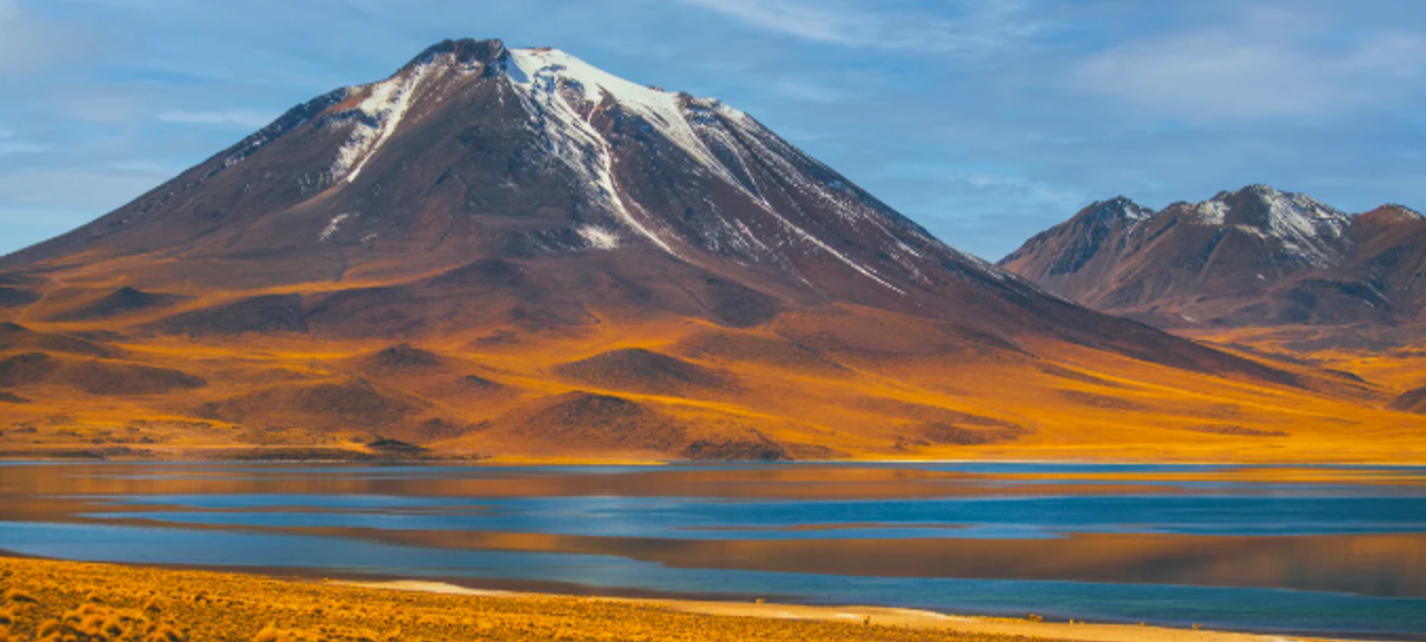
At elevations above 4,000 meters, snowmelt and groundwater collect in closed basins, forming high-altitude lagoons such as Miscanti, Miñiques, and Piedras Rojas. Surrounded by volcanoes like Licancabur and Lascar, these waters persist only because geology allows them to.
Here, turquoise lakes coexist with snow-capped peaks and wind-shaped grasslands. The contrast is not climatic. It is tectonic.

Geysers
## The Tatio Geysers: Heat Beneath the Crust
The Tatio Geysers reveal what is always happening beneath the desert's surface.
Groundwater seeps deep into the crust, where magma chambers heat it. At dawn, when cold air meets rising steam, vapor columns become visible. The spectacle is temporal, not theatrical.
Cold air reveals heat. Timing reveals process.
Living Here
## How Humans Can Live Here Without Fighting the Desert
The Atacama allows human presence only when you respect physiology.
Altitude reduces oxygen availability. Dry air accelerates dehydration. Solar radiation intensifies fatigue. Cold nights challenge recovery. These forces are constant. How people respond varies.
Medical and physiological research summarized by the [World Health Organization](https://www.who.int/) shows that gradual acclimatization, hydration, and pacing are the primary determinants of comfort at elevation. In deserts, studies cited by the [National Institutes of Health](https://www.nih.gov/) indicate that dehydration and heat stress compound faster than in humid environments, making rest and shelter as important as movement.
This is why successful habitation in the Atacama has always been structured. Ancient communities moved seasonally. Modern travelers thrive when they balance days with recovery and match exposure with shelter.
Alignment is not optional here. It is the price of admission.

Night Skies
## Stargazing and the Return of Night
The Atacama's skies are a direct extension of its dryness.
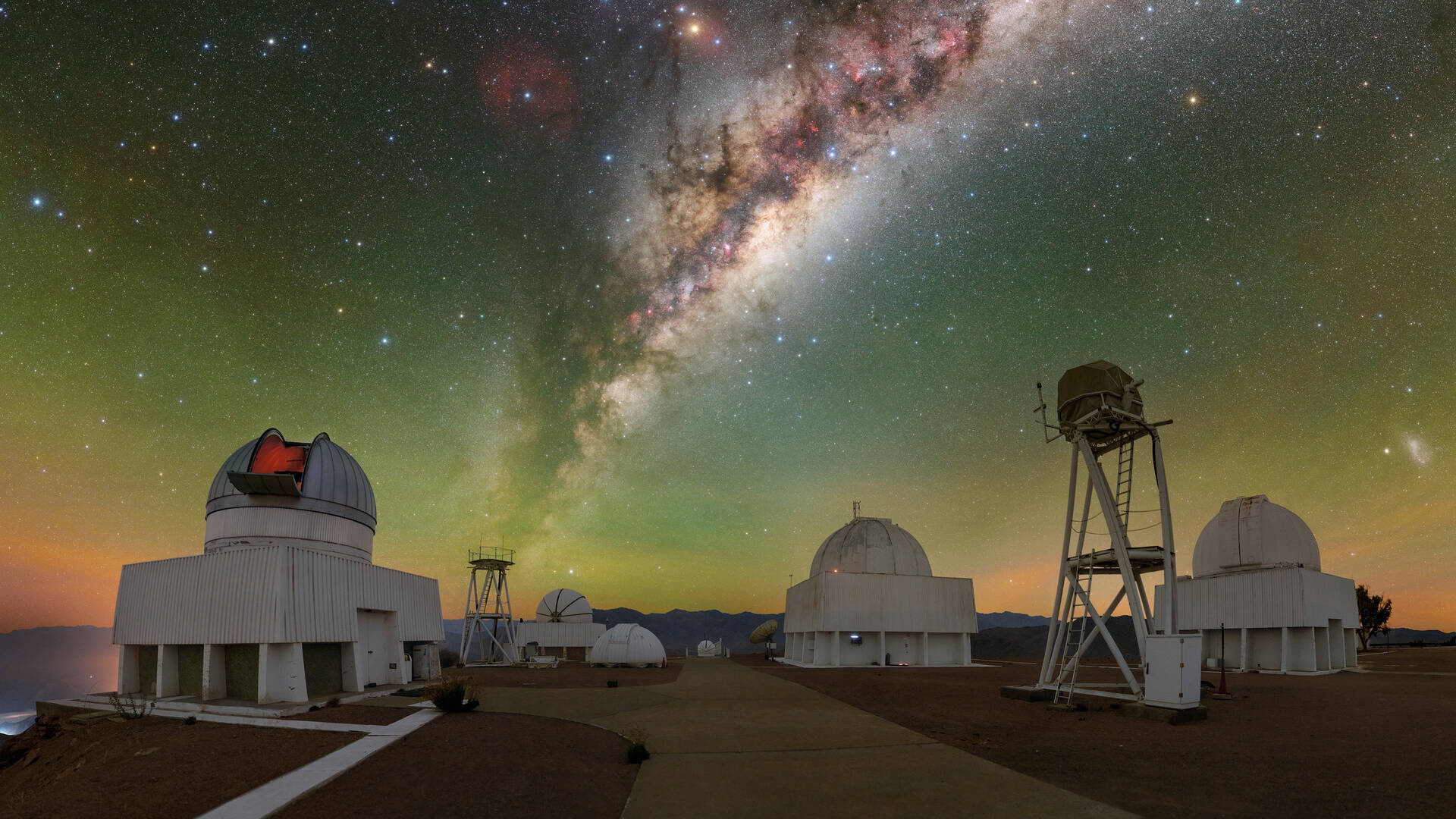
At elevations above 2,400 meters, much of the atmosphere lies below the observer. Water vapor is minimal. Cloud cover is rare. Light pollution is nearly absent. These conditions explain why northern Chile hosts the world's most advanced observatories, including those operated by the [European Southern Observatory](https://www.eso.org/public/chile/) and the [ALMA Observatory](https://www.almaobservatory.org/).
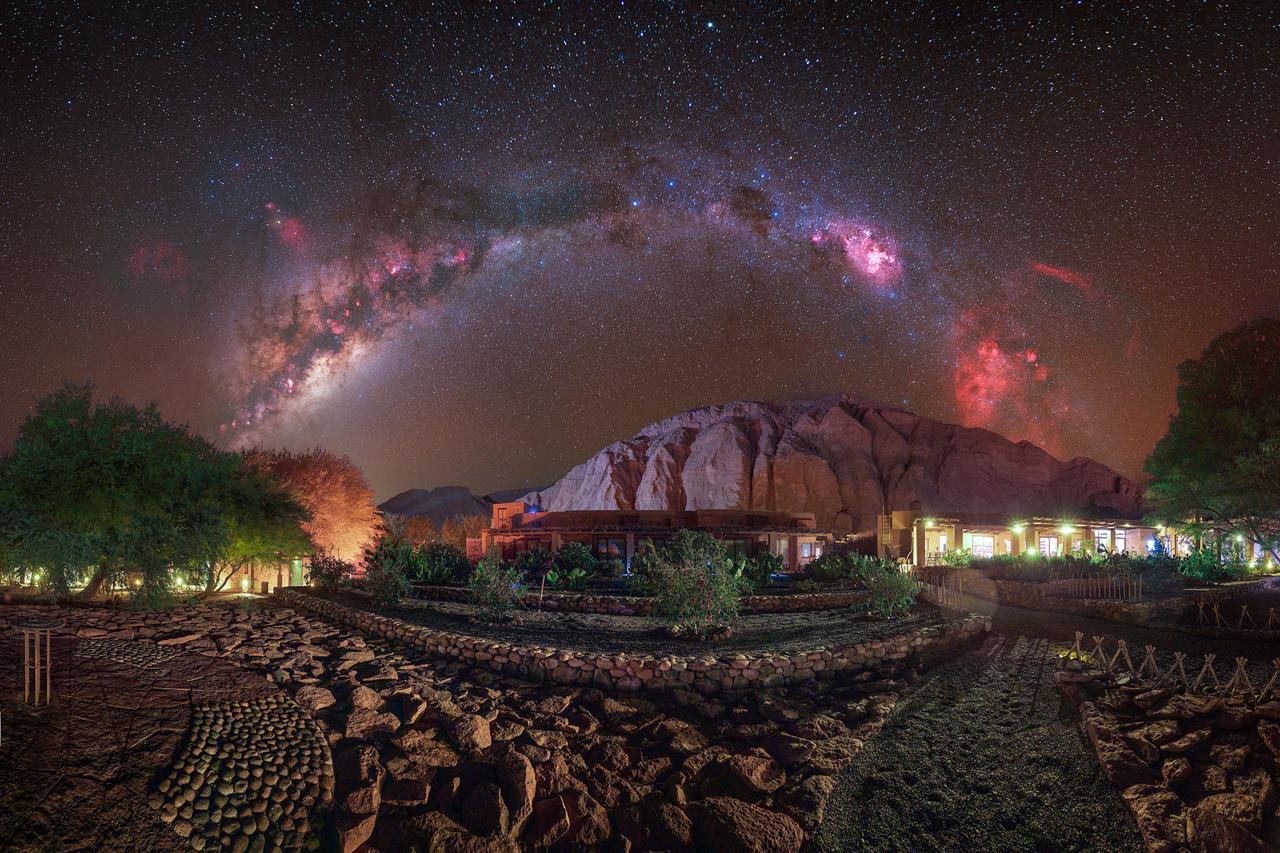
For travelers, this translates into night skies where the Milky Way appears structured rather than hazy, with dust lanes and star fields visible to the naked eye. Darkness here is not decorative. It is functional, restoring circadian rhythm and perspective in a world where night has largely disappeared.
→ Read: [Stargazing in the Atacama](https://blog.nayararesorts.com/best-stargazing-resort-atacama-desert)
Mars Analog
## The Atacama as a Mars Analog and the Future of Exploration
The same forces that limit life here make the Atacama invaluable to science.
Extreme dryness, intense ultraviolet radiation, and mineral-rich soils mirror conditions detected on Mars. Research coordinated by [NASA's Astrobiology Program](https://astrobiology.nasa.gov/) shows that microbial life in the Atacama survives underground, inside rocks, and within salt crusts, environments that shield it from radiation and desiccation.
These findings inform how scientists search for life beyond Earth. If life ever existed on Mars, it likely followed similar strategies.
The Atacama is not only a destination. It is a testing ground for the future.
→ Read: [Why the Atacama Desert Is Mars on Earth](https://blog.nayararesorts.com/mars-atacama-final-frontier-of-travel)
Today
## Living Inside the Landscape Today
Modern habitation in the Atacama succeeds when it follows ancient rules.
Movement is deliberate. Rest is intentional. Shelter is placed where the land already allows it. The desert is not conquered. It is entered.
Nayara Alto Atacama functions as a contemporary foothold within this logic. Its role is not to insulate guests from the desert, but to allow meaningful engagement without depletion. When the body is supported, the mind becomes available to the landscape.
This balance explains why the Atacama remains compelling not as spectacle, but as instruction.
Conclusion
## A Desert That Teaches
By removing water, vegetation, and excess, it exposes Earth's mechanics. Its geology explains climate. Its ecosystems explain resilience. Its skies explain time.
To be here is not to escape the planet, but to understand it more precisely. The Atacama sits at the edge of habitability, not as a warning, but as a lesson in alignment.
The Atacama does not overwhelm.
*It clarifies.*
Explore the Whole Series
## The Atacama Collection
Go deeper into the desert through stories of geology, astronomy, culture, landscape, and Nayara Alto Atacama's experiences.
01 On the Edge of Subsistence You're Here
[02 Why the Atacama Is Mars on Earth →](https://blog.nayararesorts.com/mars-on-earth-atacama) [03 Stargazing in the Atacama →](https://blog.nayararesorts.com/stargazing-atacama-desert) [04 Romance in the Atacama →](https://blog.nayararesorts.com/romance-in-the-atacama) [05 The Oasis Factor →](https://blog.nayararesorts.com/the-oasis-factor-atacama) [06 Piedras Rojas & Puritama Springs →](https://blog.nayararesorts.com/piedras-rojas-atacama) [07 The Disappearance of the World's Dark Skies →](https://blog.nayararesorts.com/why-we-need-the-night-the-disappearance-of-the-worlds-dark-skies) [08 The Uyuni Adventure: From Desert to Salt →](https://blog.nayararesorts.com/the-uyuni-adventure-from-desert-to-salt)
Nayara Alto Atacama
## Enter the Desert, Do Not Fight It
Nayara Alto Atacama is a foothold inside the Catarpe Valley oasis, built so the desert can be met without depletion.
[Explore Nayara Alto Atacama](https://nayaraaltoatacama.com/) [Check Availability](https://nayararesorts.com/#/booking/destination/dates) [Explore the Nayara Collection](https://nayararesorts.com/our-resorts/)
Nayara Horizons
## Explore the Podcast
Conversations about the people, places, cultures, and ideas behind Nayara's destinations.
01
Understanding the Atacama: A Conversation with the Atacameño Community
[Watch →](https://youtu.be/kzQWMUk49io?si=F6mKVna2uN0pO7gA)
02
Guardians of Rapa Nui: A Conversation with Tau Mana
[Watch →](https://youtu.be/FRPVRcUTNmk?si=2SrY7mElfqprkyJg)
03
The Collapse That Wasn't: A Conversation About Archaeology
[Watch →](https://youtu.be/qFVLTTJa7hE?si=LU3lrWxrFGbL6gpF)
04
The Nayara Story: A Conversation with General Manager Jairo
[Watch →](https://youtu.be/kogGcI2-pBc?si=JI-a82zE1nZODNfl)
05
A Taste of Nayara: A Conversation with Gianluca
[Watch →](https://youtu.be/NuWOobuMc2k?si=g7uHgszKtOhiMekv)
## Frequently Asked Questions
Why is the Atacama considered the driest desert on Earth? +
Because powerful geographic forces block moisture from both directions. The Andes Mountains create a strong rain shadow to the east, while the cold Humboldt Current suppresses evaporation and cloud formation along the Pacific coast.
How old is the Atacama Desert? +
Scientific evidence suggests parts of the Atacama have remained hyper-arid for 10–15 million years, making it the oldest and most stable non-polar desert on Earth.
Why does the Atacama resemble Mars? +
Its extreme dryness, high ultraviolet radiation, mineral-rich soils, and lack of vegetation closely resemble conditions detected on Mars, which is why space agencies use it as a planetary analog.
Is there life in the Atacama Desert? +
Yes, but it is highly specialized. Life survives through efficiency rather than abundance, from underground microbial communities to high-altitude fauna adapted to aridity and salinity.
Why are the Atacama skies so clear? +
High elevation, extremely low atmospheric moisture, stable air masses, and minimal light pollution combine to create some of the clearest skies on Earth.
Why is the Atacama important beyond travel? +
The desert functions as a natural laboratory for climate science, geology, astronomy, and astrobiology, helping scientists understand Earth's past and assess the possibility of life beyond our planet.
Sources & Further Reading
Desert Systems, Climate, and Geology
- NASA Earth Observatory · The Atacama Desert
- National Geographic · Why the Atacama Is So Dry
- [United States Geological Survey · Atacama geology and exposure history](https://pubs.usgs.gov/of/2010/1089/)
Astrobiology and Planetary Science
- [NASA Astrobiology Program · The Atacama Desert as a Mars analog](https://astrobiology.nasa.gov/)
- [European Southern Observatory · Astronomy in Chile](https://www.eso.org/public/chile/)
- ALMA Observatory · The Atacama Desert
Ecology and Life in Extreme Environments
- [Scientific Reports · Microbial life in hyper-arid environments](https://www.nature.com/articles/srep00538)
- United Nations Environment Program · Deserts and ecosystem resilience
[](https://blog.nayararesorts.com/why-we-need-the-night-the-disappearance-of-the-worlds-dark-skies)
## [Why We Need the Night: The Disappearance of the World’s Dark Skies](https://blog.nayararesorts.com/why-we-need-the-night-the-disappearance-of-the-worlds-dark-skies)
Oct 2, 2026
[](https://blog.nayararesorts.com/best-stargazing-resort-atacama-desert)
## [The Best Stargazing Resort in the Atacama: Nayara Alto Atacama](https://blog.nayararesorts.com/best-stargazing-resort-atacama-desert)
Jun 11, 2024
[](https://blog.nayararesorts.com/puritama-and-piedras-rojas-the-engine-under-the-desert)
## [Puritama and Piedras Rojas: The Engine Under the Desert](https://blog.nayararesorts.com/puritama-and-piedras-rojas-the-engine-under-the-desert)
Jul 6, 2026
- [Nayara Gardens](https://nayaragardens.com/)
- [Nayara Springs](https://nayarasprings.com/)
- [Nayara Tented Camp](https://nayaratentedcamp.com/)
- [Nayara Alto Atacama](https://www.altoatacama.com/)
- [Nayara Hangaroa](https://www.hangaroa.cl/)
- [Nayara Bocas Del Toro](https://bocasbali.com/)
-
-
-
-
-
-
- [Costa Rica +506 2479-1600](tel:+50624791600)
- [US +1 844-865-2002](tel:+18883322961)
- [UK +44 1617918120](tel:+441617918120)
```json
{
"@context" : "https://schema.org",
"@type" : "BlogPosting",
"author" : {
"@type" : "Person",
"name" : "Albert Ghitis",
"url" : "https://blog.nayararesorts.com/author/albert-ghitis-1"
},
"dateModified" : "2026-10-08T17:59:22.775Z",
"datePublished" : "2024-01-08T07:00:56.000Z",
"headline" : "The Atacama Desert: At the Edge of Habitability",
"image" : [ "https://blog.nayararesorts.com/hubfs/5-Jan-28-2026-12-18-54-4709-AM.png" ],
"mainEntityOfPage" : {
"@id" : "https://blog.nayararesorts.com/nayara-alto-atacama-exploring-an-alien-landscape-from-the-lap-of-luxury",
"@type" : "WebPage"
},
"publisher" : {
"@type" : "Organization",
"logo" : {
"@type" : "ImageObject",
"url" : "https://blog.nayararesorts.com/hubfs/Captura%20de%20pantalla%202023-04-13%20a%20la(s)%2010.55.13.png"
},
"name" : "Nayara Resorts"
}
}
```
```json
{
"@context" : "https://schema.org",
"@type" : "BlogPosting",
"articleSection" : "Experiences",
"author" : {
"@type" : "Organization",
"name" : "Nayara Resorts"
},
"datePublished" : "2026-01-28",
"description" : "Why humans can live in the driest non-polar desert on Earth, how its geology, ecosystems, and skies came to be, and how Nayara Alto Atacama sits within the Catarpe Valley oasis.",
"headline" : "Understanding the Atacama Desert: An Alien Landscape from the Lap of Luxury",
"image" : "https://23160175.fs1.hubspotusercontent-na1.net/hubfs/23160175/Imported_Blog_Media/Nayara-Alto-Atacama-Exploring-An-Alien-Landscape-From-the-Lap-of-Luxury-1.png",
"publisher" : {
"@type" : "Organization",
"logo" : {
"@type" : "ImageObject",
"url" : "https://blog.nayararesorts.com/hubfs/nayara-logo.png"
},
"name" : "Nayara Resorts"
}
}
```
```json
{
"@context" : "https://schema.org",
"@type" : "FAQPage",
"mainEntity" : [ {
"@type" : "Question",
"acceptedAnswer" : {
"@type" : "Answer",
"text" : "Because powerful geographic forces block moisture from both directions. The Andes Mountains create a strong rain shadow to the east, while the cold Humboldt Current suppresses evaporation and cloud formation along the Pacific coast."
},
"name" : "Why is the Atacama considered the driest desert on Earth?"
}, {
"@type" : "Question",
"acceptedAnswer" : {
"@type" : "Answer",
"text" : "Scientific evidence suggests parts of the Atacama have remained hyper-arid for 10-15 million years, making it the oldest and most stable non-polar desert on Earth."
},
"name" : "How old is the Atacama Desert?"
}, {
"@type" : "Question",
"acceptedAnswer" : {
"@type" : "Answer",
"text" : "Its extreme dryness, high ultraviolet radiation, mineral-rich soils, and lack of vegetation closely resemble conditions detected on Mars, which is why space agencies use it as a planetary analog."
},
"name" : "Why does the Atacama resemble Mars?"
}, {
"@type" : "Question",
"acceptedAnswer" : {
"@type" : "Answer",
"text" : "Yes, but it is highly specialized. Life survives through efficiency rather than abundance, from underground microbial communities to high-altitude fauna adapted to aridity and salinity."
},
"name" : "Is there life in the Atacama Desert?"
}, {
"@type" : "Question",
"acceptedAnswer" : {
"@type" : "Answer",
"text" : "High elevation, extremely low atmospheric moisture, stable air masses, and minimal light pollution combine to create some of the clearest skies on Earth."
},
"name" : "Why are the skies in the Atacama so clear?"
}, {
"@type" : "Question",
"acceptedAnswer" : {
"@type" : "Answer",
"text" : "The desert functions as a natural laboratory for climate science, geology, astronomy, and astrobiology, helping scientists understand Earth's past and assess the possibility of life beyond our planet."
},
"name" : "Why is the Atacama important beyond travel?"
} ]
}
```