The Treehouse of Your Dreams
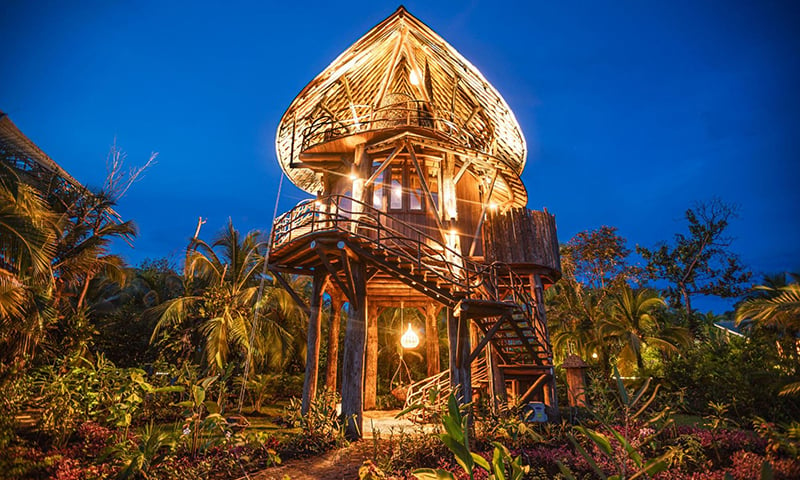
Fifty feet above the mangrove canopy at Nayara Bocas del Toro, IBUKU-designed treehouses combine structural bamboo, reclaimed hardwood, solar power and rainwater systems with an architectural tradition that has evolved from centuries-old arboreal retreats into one of luxury travel's most distinctive forms of lodging.
The height of the treehouses above the ground, with views opening across the forest, mangroves, and the Caribbean.
Varieties of centuries-old hardwood used in the original treehouse project, reclaimed from the Panama Canal floor.
Solar-powered IBUKU treehouse accommodations now rising from Nayara Bocas del Toro's private island.
In short: IBUKU, the Bali-based studio founded by Elora Hardy, designed the treehouses at Nayara Bocas del Toro. Built from locally harvested bamboo and reclaimed Panama Canal hardwood, they rise fifty feet above the ground with 21-foot ceilings, outdoor showers, copper soaking tubs, and open-air living spaces overlooking the mangrove canopy.
A Treehouse Unlike Any Other
The word "treehouse" still evokes something improvised: timber nailed into branches, a ladder, a platform, and a view. At Nayara Bocas del Toro, IBUKU takes the same instinct to climb into the canopy and turns it into architecture.
The approach is consistent with Elora Hardy's broader work: designing around the character of natural materials rather than forcing them into conventional forms. IBUKU's practice grew out of Bali's bamboo-building tradition and has developed a contemporary vocabulary of sweeping structural curves, hand-built details and buildings designed around their landscapes.
At Nayara Bocas del Toro, winding paths disappear into greenery before curving stairs begin their climb. The arrival culminates in a pivoting glass Moon Door. Beyond it, forest, mangrove, and Caribbean water replace the conventional walls of a hotel corridor.
From Arboreal Retreat to Luxury Lodging
Sleeping among trees feels contemporary, but the desire to build above the ground is much older. In his 1994 architectural survey Treehouses: The Art and Craft of Living Out on a Limb, Peter Nelson traces elaborate tree-built retreats through figures as varied as the Roman emperor Caligula, the Medici and Queen Victoria. Long before the modern treehouse hotel, elevation already carried associations of retreat, perspective and escape.
By the late twentieth century, people began to reconsider the form as serious adult architecture. Nelson's work documented structures that ranged from simple platforms to fully realized houses, helping move the treehouse in the popular imagination beyond childhood play and toward inhabitable design.
Hospitality took the idea further. Treehouse lodging offered something a conventional hotel room could not easily reproduce: a change in physical perspective. Height alters how a traveler encounters a landscape. The ground recedes. The canopy becomes immediate. Birds, branches, weather and changing light move into the foreground.
That is what separates the strongest contemporary treehouse hotels from novelty accommodations. The architecture is not valuable simply because it is elevated. It is valuable when elevation creates a more direct relationship with place. In Bocas del Toro, where forest and mangrove meet the Caribbean, that relationship is the architecture's central idea.
Bamboo and Hardwood from the Canal Floor
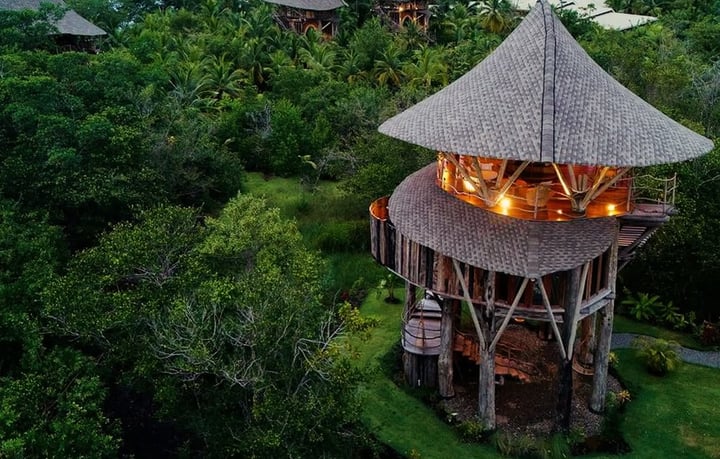
IBUKU describes the project as a mixed-material design centered on bamboo. Nayara's original treehouse documentation records four varieties of locally sourced bamboo alongside 19 varieties of reclaimed, centuries-old hardwood recovered from the floor of the Panama Canal.
Bamboo is not used here as decoration. It is structural. IBUKU has spent years developing buildings around the material's strength, flexibility, and irregular natural form, treating each pole less like standardized lumber and more like a structural element with its own geometry.
The reclaimed hardwood provides another layer of place. Material that spent centuries underwater in Panama has been brought back into use above the forest. The result is neither purely Balinese nor purely Panamanian. It exchanges the design language IBUKU developed in Bali with materials rooted in Panama itself.
Among the tall stilts, a glass Moon Door turns like a dancer on its central pivot. Overlooking the mangroves, the view wraps around us, and we feel part of it.
Elora Hardy, Founder of IBUKU
Through the Moon Door
The entrance sets the tone: a glass Moon Door pivots on its center, opening into an airy dwelling with 21-foot ceilings and floor-to-ceiling views. The open-air living room looks out over the mangrove canopy, while bamboo poles rise overhead in forms that feel as grown as constructed.
Outdoor jungle showers and hand-hammered copper soaking tubs extend the room toward the forest. A pulley can deliver meals without interrupting the sense of privacy. From the private terrace, the view stretches beyond the trees toward the ocean.
The design works because the architecture does not compete with the reason for being here. It frames the island. Luxury is not only what has been added to the room, but what the room lets the guest notice outside.
Powered by Sun, Watered by Rain
The treehouses are part of a resort IBUKU describes as fully off-grid. Solar power generates electricity, while water systems rely on collected and purified rainwater. Wastewater is treated before being discharged into the surrounding marine environment.
Those systems matter because Bocas del Toro is not simply a tropical backdrop. The Smithsonian Tropical Research Institute has studied the archipelago's interconnected mangrove, seagrass and coral ecosystems for decades. Its long-term monitoring in Bocas dates to 1999.
In that context, off-grid infrastructure becomes part of the architecture. The question is not only how to build an extraordinary room in the canopy, but how to operate it on an island where the forest, mangroves and sea are physically connected.
Read: How We Built an Off-Grid Resort →The Island Around Them
Roughly 9,000 years ago, rising seas isolated what are now the mangrove-fringed islands of the Bocas del Toro archipelago. Today, the region contains an unusually close mosaic of mangroves, coral reefs, seagrass beds, lowland rainforest and other tropical habitats.
Panama's environmental authorities continue to emphasize the ecological role of Bocas del Toro's mangroves as habitat, natural coastal protection, and part of the region's broader marine system. From the treehouses, those mangroves are not an abstract conservation issue. They are the immediate view.
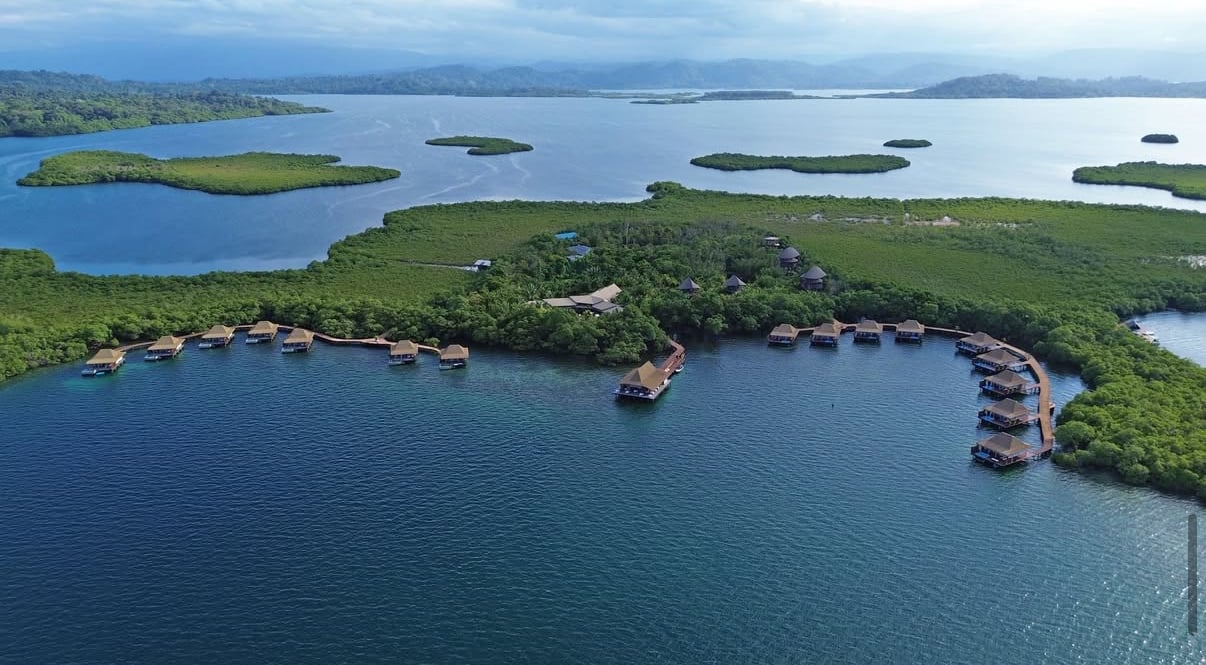
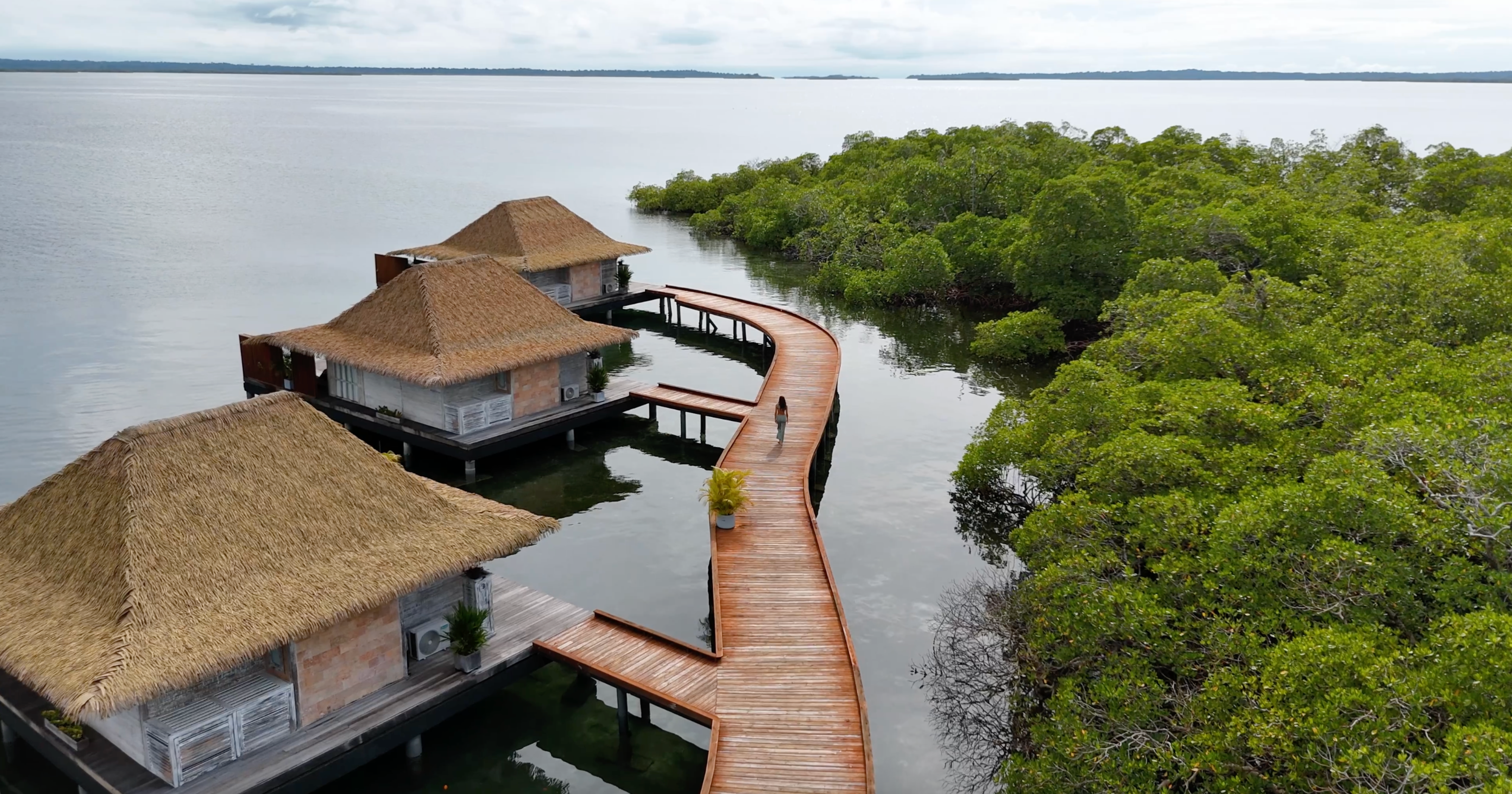
Elsewhere on Isla Frangipani, the treehouses sit alongside overwater villas, restaurants, a freshwater pool and the resort's elevated white-sand beach. Guests can move from the canopy to the sea without leaving the island.
That movement explains the treehouses better than any list of amenities. They are one way of experiencing an island defined by vertical layers: reef below the water, mangrove at its edge, rainforest above it, and a guest room suspended in the canopy.
Sleep Fifty Feet Above the Forest
IBUKU treehouses, overwater villas and an adults-only private island in Panama's Bocas del Toro archipelago.
Albert Ghitis leads digital marketing at Nayara Resorts, overseeing editorial, email strategy, organic social, paid social, search, and AI discovery. He also hosts Nayara Horizons. Explore the latest episodes below.
Explore the Podcast
Conversations about the people, places, cultures and ideas behind Nayara's destinations.
IBUKU Treehouses
Who designed the treehouses at Nayara Bocas del Toro? +
How many treehouses are at Nayara Bocas del Toro? +
What are the treehouses made of? +
How tall are the treehouses? +
Are the treehouses off-grid? +
Is Nayara Bocas del Toro adults-only? +
- Nayara Bocas del Toro · Treehouse Accommodations
- IBUKU · Nayara Bocas del Toro Tree House Project
- IBUKU · New York Times Coverage of the Four Treehouses
- Nayara Resorts · The Treehouse of Your Dreams
- IBUKU · Bamboo, Materials and Design Philosophy
- Peter Nelson · Treehouses: The Art and Craft of Living Out on a Limb
- Penguin Random House · Peter Nelson and Modern Treehouse Architecture
- Smithsonian Tropical Research Institute · Bocas del Toro
- Smithsonian Tropical Research Institute · Mangrove, Seagrass and Coral Monitoring
- Panama Ministry of Environment · Mangrove Conservation in Bocas del Toro