Independent environmental studies commissioned before a single stilt was placed.
Solar energy. No diesel generator, no mainland grid, no exceptions.
Dredging, land clearing, or wastewater discharge into the surrounding sea.
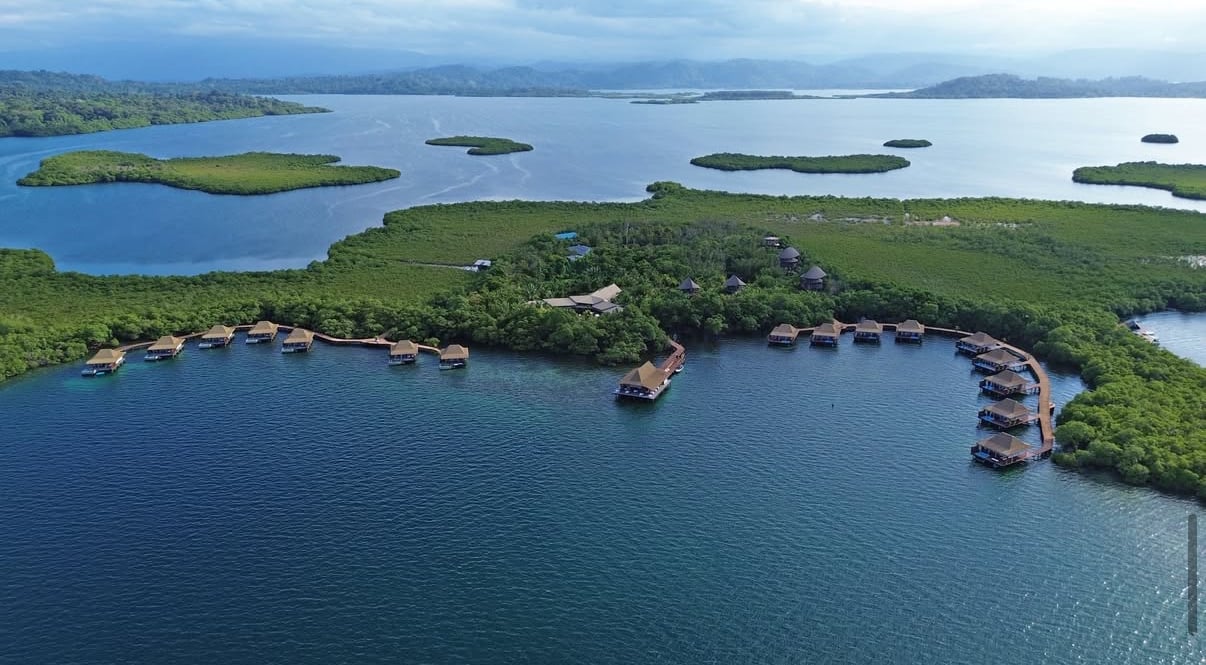
In short: Nayara Bocas del Toro was built entirely off-grid on a private island in Panama's Bocas del Toro archipelago. Five environmental studies came before construction, every structure stands on stilts above intact mangrove roots, all power is solar with no diesel backup, all fresh water is harvested rain, and nothing is discharged into the sea.
How to Build a Resort Without Breaking the Ecosystem
No roads. No grid. No municipal water.
Bocas del Toro is a protected archipelago on Panama's Caribbean coast. Its mangrove forests, coral reefs, and seagrass beds form one of the most biodiverse marine ecosystems in the Western Hemisphere. When we decided to build here, the question was never whether we could. It was whether we could do it without harming what made the place worth building in the first place.
The answer required rethinking everything. There would be no connection to a mainland power grid. No municipal water supply. No roads leading to the site. No dredging, no clearing, no compromise with the native mangroves and the coral below. We would build Nayara Bocas del Toro entirely off-grid, and the island would be healthier for it.
Five Environmental Studies Before Construction Began
Before construction, five independent environmental impact assessments were commissioned. These were not formalities. They became the foundation of every design decision that followed.
Marine ecosystem survey. A comprehensive mapping of coral coverage, seagrass distribution, and marine species in the surrounding waters. This determined where structures could stand without disrupting existing reef systems.
Mangrove root network analysis. A detailed study of the root systems along the island's perimeter. Every stilt placement was designed to avoid root zones, and boat channels were mapped to prevent prop-wash damage.
Hydrological assessment. Analysis of tidal flows, storm-surge patterns, and freshwater lens dynamics. This set the elevation of every structure and shaped the rainwater harvesting design.
Terrestrial biodiversity inventory. A catalog of every plant and animal species on the island. Construction zones were chosen to minimize habitat displacement, and native vegetation was preserved in place wherever possible.
Waste and water systems engineering. A complete off-grid infrastructure plan: solar capacity modeling, rainwater collection volumes, UV purification specifications, and wastewater treatment designed to produce zero discharge into the surrounding waters.
Overwater Villas on Stilts, Above Mangroves and Coral
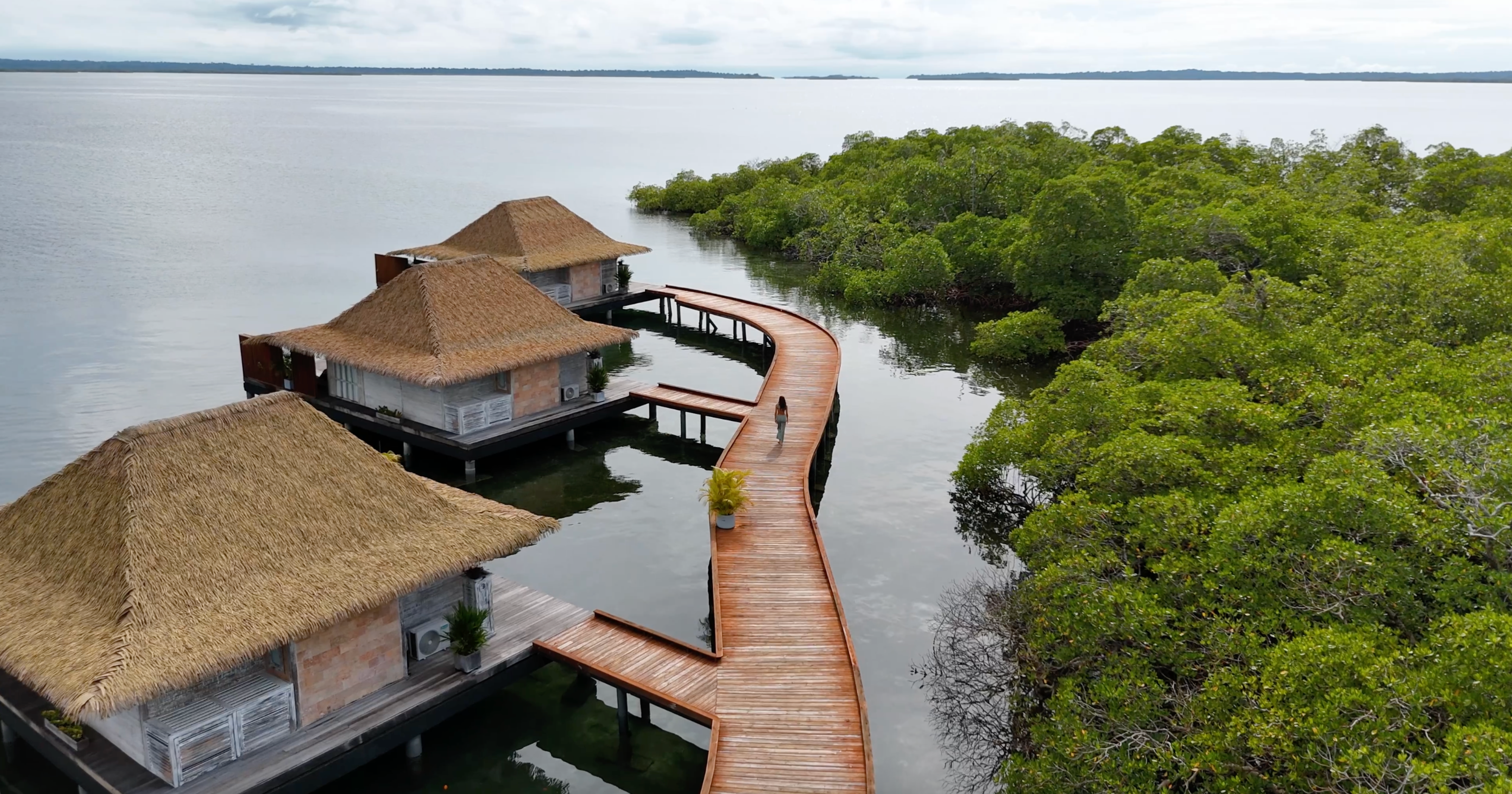
The entire resort stands on stilts above the water and the forest floor. Elevating every structure preserved the mangrove root networks below, maintained natural water flow, and left undisturbed the sediment that feeds the surrounding reef.
There was no dredging. No land clearing. No concrete foundations poured into the seabed. Each stilt was placed according to the root network analysis, so the island's circulatory system stayed intact.
Construction materials were selected to eliminate chemical leaching into the water column. The measure of success: from below the waterline, the resort should be invisible to the ecosystem.
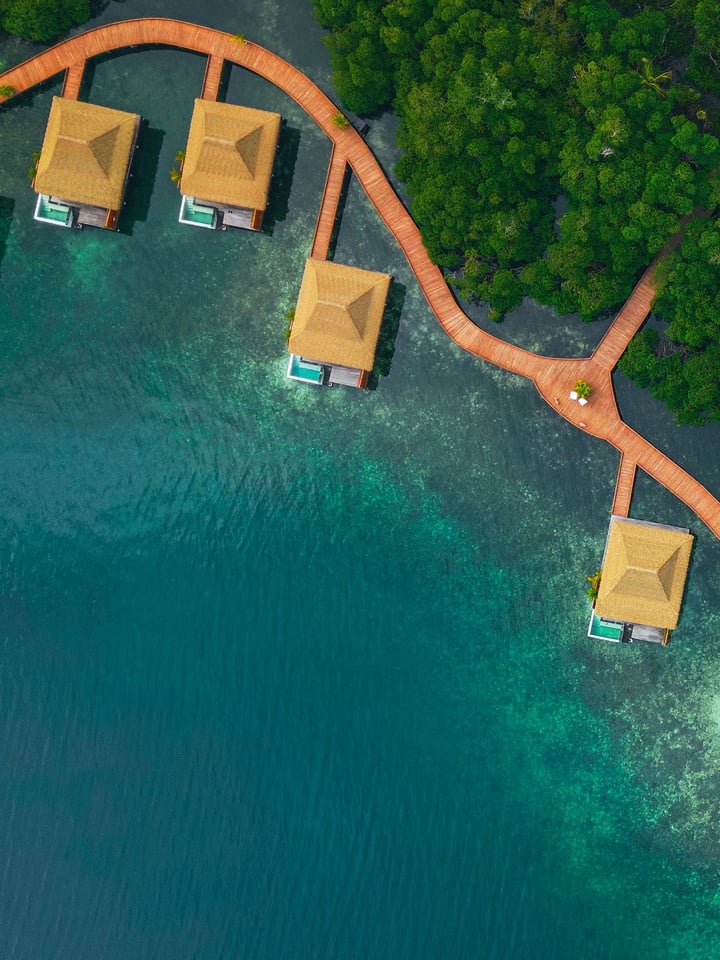
Every villa elevated above the water. Every mangrove root system preserved beneath.
Sun, Rain, and Nothing Else
100% solar energy. The entire resort runs on photovoltaic panels. There is no diesel generator behind the curtain and no cable to a mainland grid. Every watt that powers the guest experience, the kitchens, the spa, and the water treatment systems comes from the Caribbean sun.
100% harvested rainwater. All fresh water is collected from the island's rainfall, stored in cisterns, and purified by UV treatment. No aquifer is tapped. No mainland supply is piped in. The system was designed to handle the archipelago's wet and dry seasons without external input, and wastewater is treated on site to a standard that allows zero discharge into the surrounding sea.
The Mangroves Run the Place
Mangroves are the connective tissue of this ecosystem. Their roots filter sediment and runoff before it reaches the reef. They shelter juvenile fish. They hold the shoreline against storm surge. They sequester carbon at rates up to four times higher than terrestrial forests.
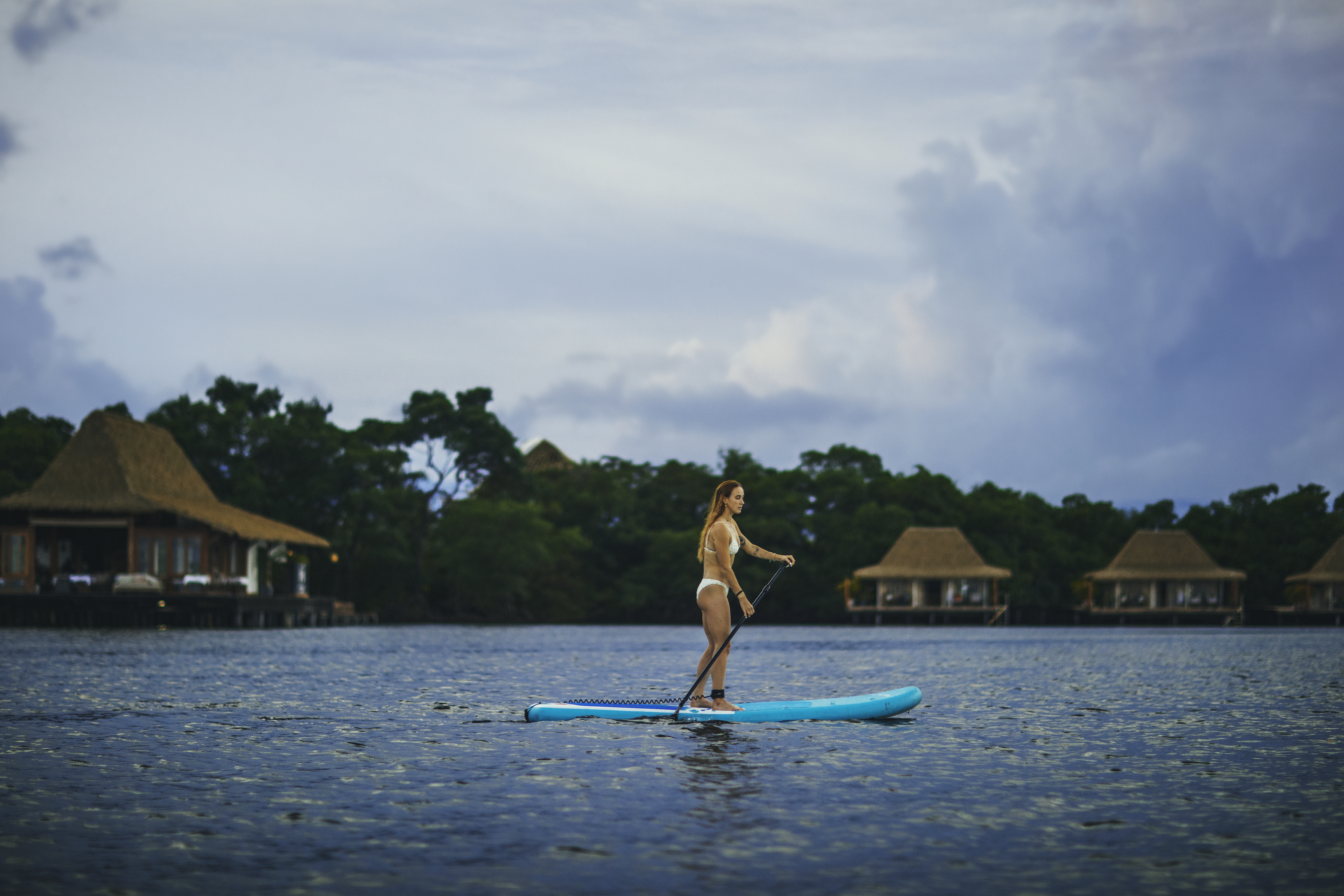
Their protection is embedded in daily operations. Boat routes avoid prop wash in sensitive root zones. Exterior lighting is managed so nocturnal species that depend on the mangrove canopy are not disrupted. Kayak routes follow designated channels, and snorkeling excursions to the mangrove-reef transition zones are led by naturalists who understand how sensitive these areas are.
Guests get closer to the mangroves here than almost anywhere in the archipelago. The routes simply make sure every encounter leaves the system stronger than it was found.
IBUKU Treehouses: 50 Feet Above the Forest
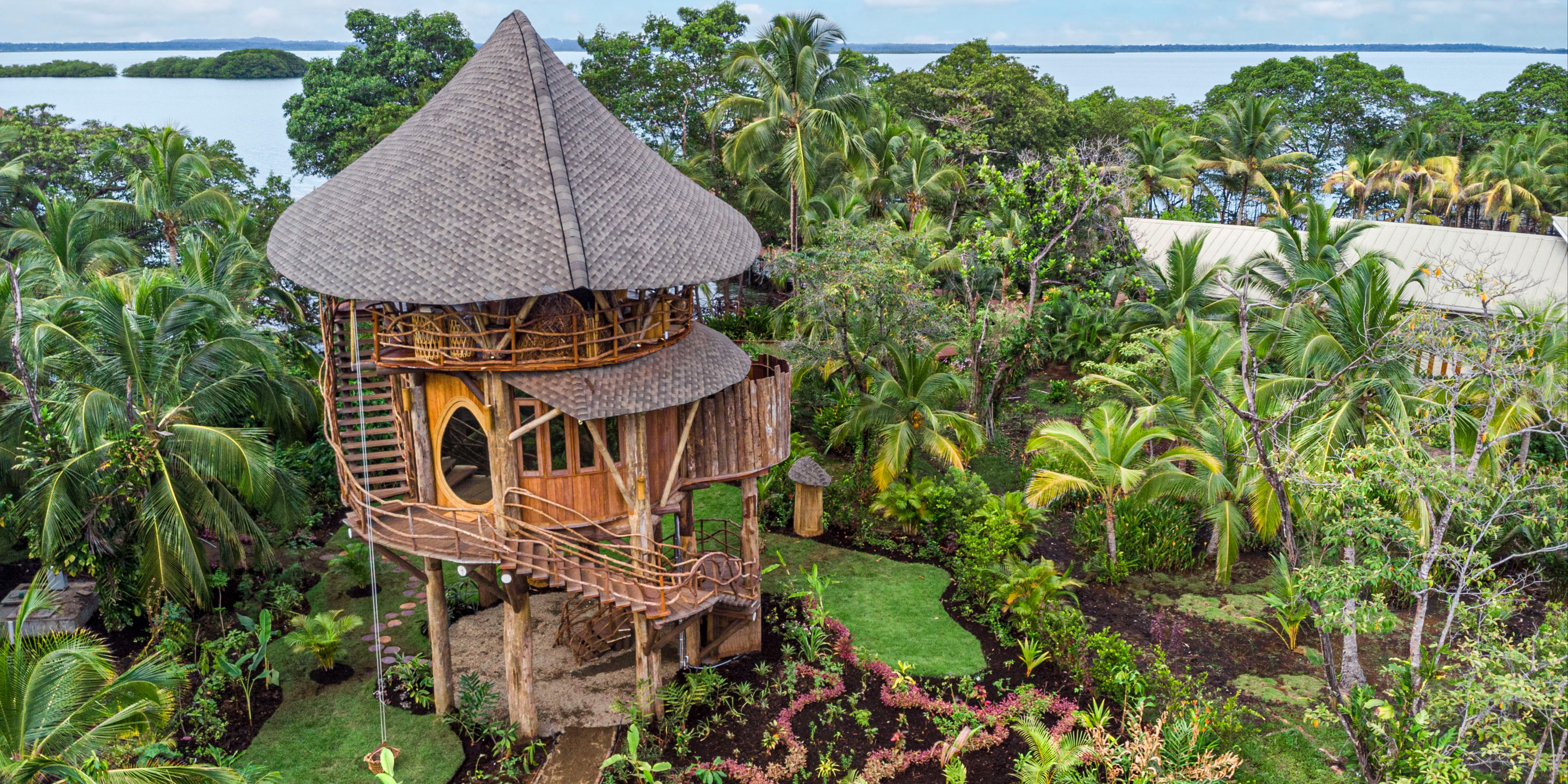
The treehouses were designed by IBUKU, the Bali studio led by Elora Hardy, and they follow the same principle as everything else on the island: build up, not out. Touch the ground as lightly as possible.
Built from locally harvested bamboo and hardwood reclaimed from the depths of the Panama Canal, they rise fifty feet above the forest floor, looking out over mangroves and open ocean. Balinese craftsmanship, Panamanian materials, and a result that feels both ancient and entirely new.
The bamboo is not decorative. It is structural. These are load-bearing organic forms with no steel frame and no concrete core. Just engineered bamboo, tropical hardwood, and the Caribbean wind. Read: IBUKU Treehouses →
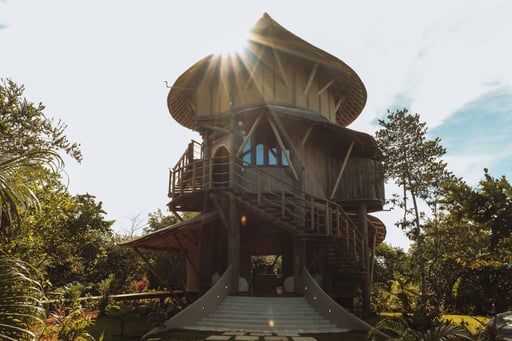
The mangroves filter the water. The water feeds the seagrass. The seagrass shelters the fish. The fish populate the reef. The reef protects the shore. You protect all of it, or you protect none of it.
Building Was Just the Beginning
Once the resort opened, the work shifted from construction to restoration. In 2022 we partnered with the Caribbean Coral Restoration Center to begin actively rebuilding the marine ecosystem in our bay. Ten artificial reef structures have been installed. Genetically resilient coral fragments are being outplanted. Marine life has already begun returning.
The resort earned Green Globe certification, audited annually against 380 indicators spanning environmental management, social responsibility, cultural heritage, and economic performance. It is not a label. It is an annual exam. Read: Green Globe & Sello S →
The long-term goal is larger than one bay: to scale ocean habitat restoration across the Bocas del Toro archipelago, and to leave a model that other hotels, communities, and governments in the region can replicate.
Explore the Full Bocas Series
The private island Condé Nast Traveler readers named #1 in Central America, from the seabed up.
Frequently Asked Questions
Is Nayara Bocas del Toro really off-grid?+
Was anything dredged or cleared to build the resort?+
Who designed the treehouses?+
What is the resort doing for the coral reef?+
Is Nayara Bocas del Toro sustainability certified?+
- Caribbean Coral Restoration Center: the reef-restoration partner
- Green Globe: certification standard and annual audit criteria
- IBUKU: the bamboo architecture studio led by Elora Hardy
- NOAA: mangrove ecosystems, carbon sequestration, and nursery habitat
Stay on the Island That Runs on Sun and Rain
Overwater villas and bamboo treehouses above a living reef, in Panama's Bocas del Toro archipelago.