---
title: Wildlife Conservation in Arenal and Bocas del Toro
description: Winter reveals the Atacama at its clearest. Cooler days, longer nights, and exceptional atmospheric clarity make winter the ideal season to explore Chile’s most extreme desert.
image: https://blog.nayararesorts.com/hubfs/Swimming-Sloth-1024x683.jpg
---
[Blog](https://blog.nayararesorts.com/)
[](https://nayararesorts.com/)
SUBSCRIBE
# Wildlife Conservation in Arenal and Bocas del Toro
[Albert Ghitis](https://blog.nayararesorts.com/author/albert-ghitis-1)
Feb 28, 2026
Key Findings
7–10%
Of all known species on Earth live in Central America, on less than 0.5 percent of its land area.
40,000+
Native trees planted at Nayara Tented Camp, turning cleared pasture into a habitat corridor. The sloths returned on their own.
1
System, not three: in Bocas del Toro, reef, mangrove, and rainforest depend on one another. Treat them separately and conservation fails.=
In This Article
10 min read
[01The Land Bridge and What It Means](https://blog.nayararesorts.com/wildlife-conservation-in-arenal-and-bocas-del-toro#land-bridge) [02Turning Pasture Back into Forest](https://blog.nayararesorts.com/wildlife-conservation-in-arenal-and-bocas-del-toro#reforestation) [03The Ecological Roles That Actually Matter](https://blog.nayararesorts.com/wildlife-conservation-in-arenal-and-bocas-del-toro#roles) [04Bocas del Toro: One System](https://blog.nayararesorts.com/wildlife-conservation-in-arenal-and-bocas-del-toro#one-system) [05Four Species and What Their Presence Means](https://blog.nayararesorts.com/wildlife-conservation-in-arenal-and-bocas-del-toro#four-species) [06What Comes Next](https://blog.nayararesorts.com/wildlife-conservation-in-arenal-and-bocas-del-toro#next) [07Frequently Asked Questions](https://blog.nayararesorts.com/wildlife-conservation-in-arenal-and-bocas-del-toro#faq)
World Wildlife Day · Part 1
## The Land Bridge and What It Means
**In short:** Central America holds an estimated 7 to 10 percent of all known species on Earth in less than half a percent of its land. Around Nayara's Costa Rica and Panama resorts, that abundance is not scenery. A reforestation program at Nayara Tented Camp brought sloths back to former pasture on their own, and in Bocas del Toro, reef, mangrove, and rainforest work as one system where every species present is a verdict on the whole.
Every year on March 3, [World Wildlife Day](https://www.worldwildlifeday.org/) prompts a global conversation about the species we share this planet with. The [United Nations](https://www.un.org/en/observances/world-wildlife-day) established the observance in 2013 to build accountability around the pressures that push species toward the margins: habitat destruction, illegal trade, climate change, and the compounding effects of human development on the ecosystems wild animals depend on.
We operate inside two ecosystems of global biological significance: Costa Rica's Arenal region and Panama's Bocas del Toro archipelago. The animals that live here, in the canopy above our properties, in the reef below our overwater villas, in the mangroves lining our island shores, are not amenities. Their presence reflects real ecological conditions. Their wellbeing is both a measure of ours and a responsibility we accepted when we chose to build here.
Central America's biodiversity is a consequence of geography. For most of the planet's history, North and South America were separate continents, each evolving its own fauna in isolation. When the Isthmus of Panama closed roughly three million years ago, the biological exchange that followed was one of the most significant events in the history of life on land. Species moved in both directions. Populations diverged into new forms as they adapted to unfamiliar habitats. Marine species separated as the Atlantic and Pacific became distinct bodies of water.
What remained was a narrow strip of land with a disproportionate share of the world's biological complexity. Costa Rica, with an estimated 500,000 species in a territory roughly the size of West Virginia, holds a larger share of global biodiversity than most continents. The [Arenal Conservation Area](https://www.sinac.go.cr/) alone spans more than 500,000 acres, climbing from lowland rainforest through cloud forest as a vertical cross-section of that complexity, stacking distinct ecosystems on top of one another along its volcanic slopes.
This context changes the stakes of every development decision. When habitat is fragmented here, the consequences ripple across a web of interdependencies that took millions of years to form. Restoration, in turn, is not about one species or one parcel. It is about reconnecting a system.
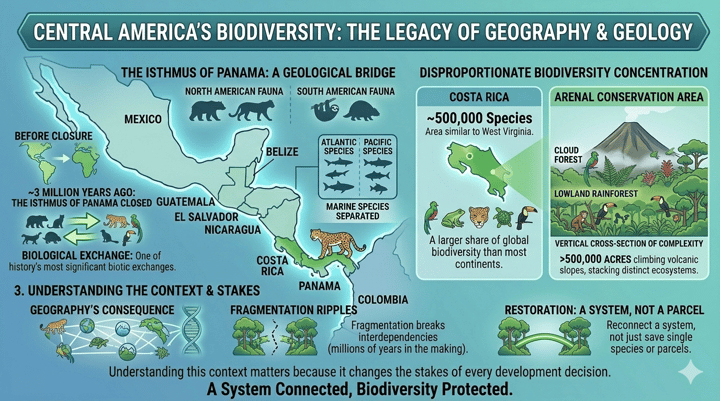
A narrow strip of land holding a disproportionate share of the world's biological complexity.
Arenal
## Turning Pasture Back into Forest
The land beneath Nayara Tented Camp was cleared pasture when we acquired it. Open. Exposed. Functionally empty. No canopy, no food web, no connection to the surrounding rainforest. We made a decision early: this would not be a project built on degraded land. It would be a project that reversed it.
The work began with species selection. Fast-establishing native trees rebuilt canopy quickly while restoring habitat at the same time, more than 40,000 in all. Cecropia became foundational: it colonizes disturbed land rapidly and produces the leaves sloths depend on. As the canopy closed, structure returned. Shade stabilized the understory. Insects reappeared. Movement corridors formed overhead.
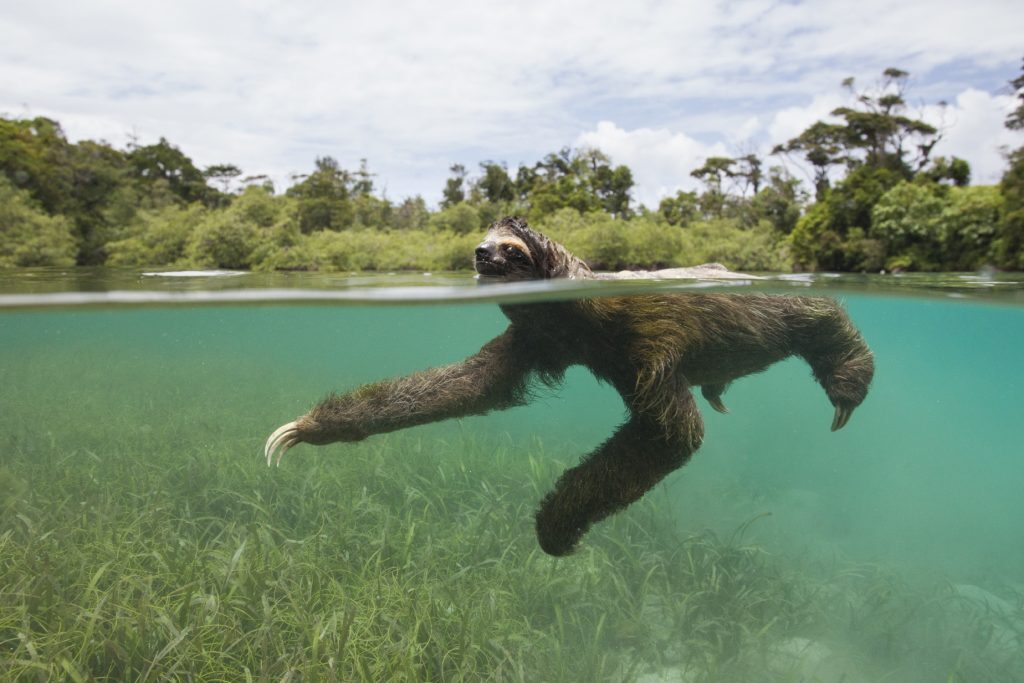
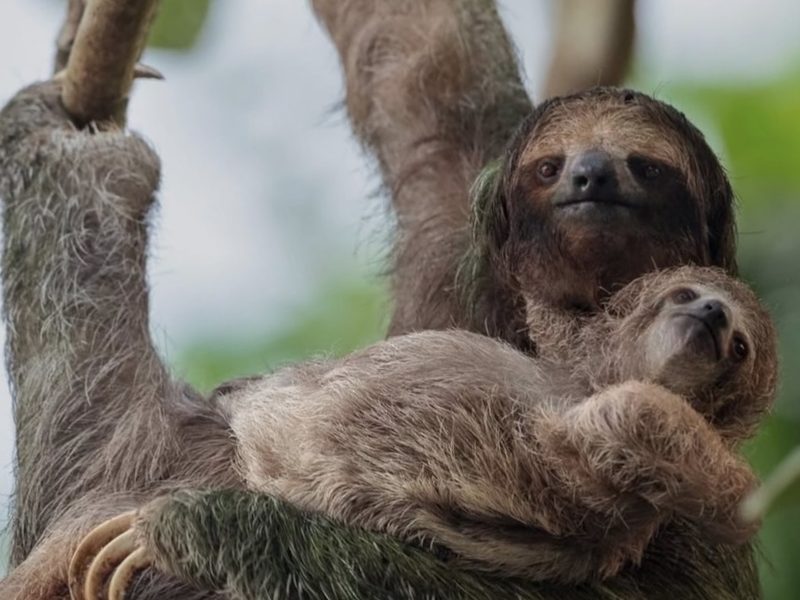
The sloths came back on their own. That is the only outcome that matters. When the right trees are planted in the right way, wildlife follows the food. Two species now live here year-round, monitored by resident naturalists tracking movement, condition, and habitat use. The sloth is not a symbol. It is a living measure of whether the forest is functioning. [Read: What the Sloth Reveals ↗](https://blog.nayararesorts.com/rom-deadly-sin-to-rainforest-royalty-the-soul-of-nayara)
A Living Audit
## The Ecological Roles That Actually Matter
Wildlife coverage tends to focus on charisma: size, color, rarity. But the species that matter most to an ecosystem are often the ones doing the least visible work. Three animals in the Arenal ecosystem show what happens when you look past spectacle to function.
**The toucan family.** Keel-billed, chestnut-mandibled, and collared aracári toucans move through the mid-canopy eating large fruits most birds cannot process. As documented by the [Cornell Lab of Ornithology](https://www.birds.cornell.edu/home), they are among the most effective seed dispersers in Neotropical forests, carrying seeds in their gut across the distances that decide where the next generation of large-seeded trees germinates.
**The mantled howler monkey.** The [IUCN Red List](https://www.iucnredlist.org/) records the Arenal population as stable, a conservation achievement worth naming. Howlers are canopy-dependent and cannot safely cross open ground, so every break in forest cover is a hard barrier to movement, gene flow, and population health. The corridors Nayara has planted are, among other things, howler monkey infrastructure. Their morning calls across the valley are not atmosphere. They are evidence the corridors hold.
**The white-nosed coati.** Often dismissed as approachable and unexceptional, coatis are ecosystem engineers. Their foraging turns soil, suppresses insects, and disperses seeds across the undergrowth in ways that shape the forest floor over time. Ecosystems without enough mid-level foragers show measurable degradation in structure and diversity. The coati's abundance here is another verdict: the understory is intact. Each species tells you something specific about the health of the system it occupies. Together, they are a living audit.
.png?width=720&height=360&name=Meeting%20The%20Toucans%20of%20Arenal%20Rainforest%20%20Who%20They%20Are%2c%20and%20How%20to%20See%20Them%20(1).png)
Lose the toucans and you lose more than the spectacle: you lose a mechanism of forest regeneration.
A sloth does not care about our intentions. The only thing any animal responds to is whether the conditions for life are present or absent. That is the standard. Everything else is narrative.
Bocas del Toro
## One System, Not Three
The standard way to describe Bocas del Toro is as a place where reef, mangrove, and rainforest meet. That framing is convenient but misleading. These are not three ecosystems that happen to share a coastline. They are a single functioning system in which each component is structurally dependent on the others.
The [Smithsonian Tropical Research Institute](https://stri.si.edu/facility/bocas-del-toro) has studied this system since establishing its station here in 1998, and its research shows the causal chains run in every direction. Mangrove roots filter the terrestrial runoff that would otherwise smother reef corals. Reef structures shelter juvenile fish that will eventually feed the dolphins and sharks patrolling deeper water. Rainforest canopy stabilizes soils that, if eroded, would carry sediment into shallow-reef zones and cut off the light coral requires. Seagrass meadows between mangrove and reef are the feeding grounds sea turtles depend on.
Conservation strategies that treat any one component in isolation are not conservation strategies. They are delay. At Nayara Bocas del Toro, whole-system awareness shapes decisions about where boats travel, how lighting is managed, what materials enter the water, and when and how guests reach sensitive zones. [Read: Nature-Based Wellness ↗](https://blog.nayararesorts.com/nature-based-wellness-at-nayara-resorts-how-deserts-rainforests-oceans-and-night-skies-shape-human-health)
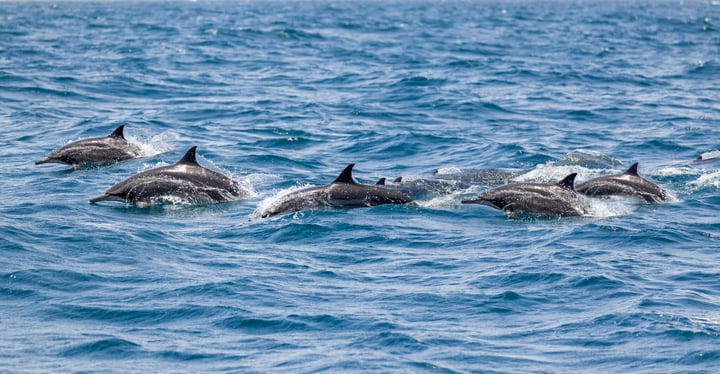
Not three ecosystems sharing a coastline. One system in which each part depends on the others.
Four Verdicts
## Four Species and What Their Presence Means
If an animal's presence is a verdict on the system it inhabits, the waters of Bocas del Toro are delivering four at once.
**Bottlenose and spinner dolphins.** Dolphin Bay's resident populations are among the most reliable indicators of water quality and prey abundance in the archipelago. Dolphins sit near the top of the aquatic food chain, so their sustained presence means the trophic levels beneath them are functioning at scale. A decline would be an early warning of systemic stress that might not register any other visible way until it was already severe.
**Leatherback sea turtles.** The largest living reptile and one of the most ancient lineages of animal, leatherbacks nest on Bocas del Toro's beaches between March and July. [NOAA Fisheries](https://www.fisheries.noaa.gov/species/leatherback-sea-turtle) documents their transoceanic migrations of thousands of miles; they return to the same Caribbean beaches year after year. Their nesting depends on beach quality, darkness, and the absence of boat traffic and disorienting light that causes females to abandon a nesting attempt and return to sea. Every nest is a verdict on whether we protected the conditions they require.
**Nurse sharks.** According to the [Florida Museum Shark Research Program](https://www.floridamuseum.ufl.edu/discover-fish/species-profiles/ginglymostoma-cirratum/), nurse sharks are benthic predators that rest on the seafloor by day and hunt invertebrates at night. Docile and easy to overlook, their density in Bocas' shallow reefs reflects the health of the seafloor communities they feed on and the absence of overfishing that depletes them elsewhere. Globally, the [IUCN](https://www.iucnredlist.org/) estimates roughly a quarter of shark and ray species are now threatened, which makes healthy populations here a genuine bright spot rather than a given.
**Panamanian night monkeys.** Research in the [American Journal of Primatology](https://onlinelibrary.wiley.com/journal/10982345) describes their dependence on undisturbed habitat and near-total darkness for foraging and reproduction. Artificial light at the wrong intensity disrupts their activity cycles and compresses their habitat range. Monitoring them near the property is one way we check whether our light-management practices are working.
The Standard
## What Comes Next
The UN's framing for World Wildlife Day is consistently future-facing: what does the next generation inherit, and what choices determine it. For us the question is more immediate. What choices are we making right now, in the properties we manage and the ecosystems we operate inside, that will decide whether the species living here continue to.
A sloth does not care about our intentions. A leatherback does not read our sustainability reports. A howler monkey does not distinguish between a resort that claims to protect the forest and one that actually does. The only thing any of them responds to is whether the conditions for life are present or absent.
That is the standard. Everything else is narrative. Part 2 of this series follows the same logic to the other extreme, the driest desert on Earth and the most isolated island in the Pacific. [Read: Part 2, Atacama and Rapa Nui ↗](https://blog.nayararesorts.com/wildlife-conservation-in-the-atacama-and-rapa-nui)
## Frequently Asked Questions
Why is Central America one of the most biodiverse regions on Earth?+
The Isthmus of Panama formed roughly three million years ago, connecting two continents that had evolved in isolation and triggering a massive biological exchange. The resulting overlap of North and South American species, combined with dramatic elevation gradients and multiple climate zones compressed into a narrow land bridge, produced extraordinary species density in a very small area.
How do mangroves protect coral reefs?+
Mangrove root systems filter terrestrial runoff, trapping sediment and absorbing excess nutrients before they reach the reef. Without that filtration, sediment smothers coral and nutrient overload fuels algal blooms that outcompete reef-building species. In Bocas del Toro, the proximity of mangrove, seagrass, and reef makes the relationship unusually direct.
How did sloths return to Nayara's grounds?+
Through the reforestation program. Sloths depend on continuous canopy cover and specific food sources, especially cecropia. As the more than 40,000 planted trees matured and the canopy closed, the conditions sloths require were restored. They were not introduced. They moved in when the conditions were right.
Are the dolphins in Bocas del Toro resident or migratory?+
Resident. Bottlenose and spinner dolphins live year-round in the protected channels of the archipelago, which provide the calm water and prey availability that support permanent populations.
Why does light management matter for night monkeys and sea turtles?+
Both are highly sensitive to artificial light. Leatherback females will abandon nesting attempts on beaches they perceive as too bright, and night monkeys require near-darkness to forage and reproduce successfully. Lighting protocols at Nayara Bocas del Toro are designed with both in mind.
Can guests observe wildlife without disturbing it?+
Yes. On-staff naturalists guide all wildlife observation at both the Arenal and Bocas del Toro properties, with protocols designed to minimize disturbance. Observation distance, timing, and behavior norms are calibrated to the specific sensitivities of each species encountered.
Sources and Further Reading
[World Wildlife Day, United Nations](https://www.un.org/en/observances/world-wildlife-day) · [World Wildlife Day, Official Site](https://www.worldwildlifeday.org/) · [SINAC, Costa Rica National System of Conservation Areas](https://www.sinac.go.cr/) · [Smithsonian Tropical Research Institute, Bocas del Toro](https://stri.si.edu/facility/bocas-del-toro) · [Cornell Lab of Ornithology](https://www.birds.cornell.edu/home) · [IUCN Red List](https://www.iucnredlist.org/) · [NOAA Fisheries: Leatherback Sea Turtle](https://www.fisheries.noaa.gov/species/leatherback-sea-turtle) · [Florida Museum: Nurse Shark](https://www.floridamuseum.ufl.edu/discover-fish/species-profiles/ginglymostoma-cirratum/) · [American Journal of Primatology](https://onlinelibrary.wiley.com/journal/10982345)
Plan Your Stay
## Stay where the wildlife is the verdict
The replanted rainforest of Arenal or the reef-and-mangrove system of Bocas del Toro, each with a resort built to protect it.
[Stay at Nayara Tented Camp](https://nayaratentedcamp.com)
[Stay at Nayara Springs](https://nayarasprings.com)
[Stay at Nayara Bocas del Toro](https://nayarabocasdeltoro.com)[Stay at Nayara Gardens](https://nayaragardens.com)
[](https://blog.nayararesorts.com/7-michelin-keys-3-countries-1-commitment)
## [7 MICHELIN Keys. 3 Countries. 1 Standard of Excellence](https://blog.nayararesorts.com/7-michelin-keys-3-countries-1-commitment)
Mar 1, 2026
[](https://blog.nayararesorts.com/exploring-the-rich-wildlife-and-natural-world-of-nayara-resorts)
## [Costa Rica Animals and Wildlife: Sloths, Toucans, and More at Nayara in Arenal](https://blog.nayararesorts.com/exploring-the-rich-wildlife-and-natural-world-of-nayara-resorts)
Nov 23, 2023
[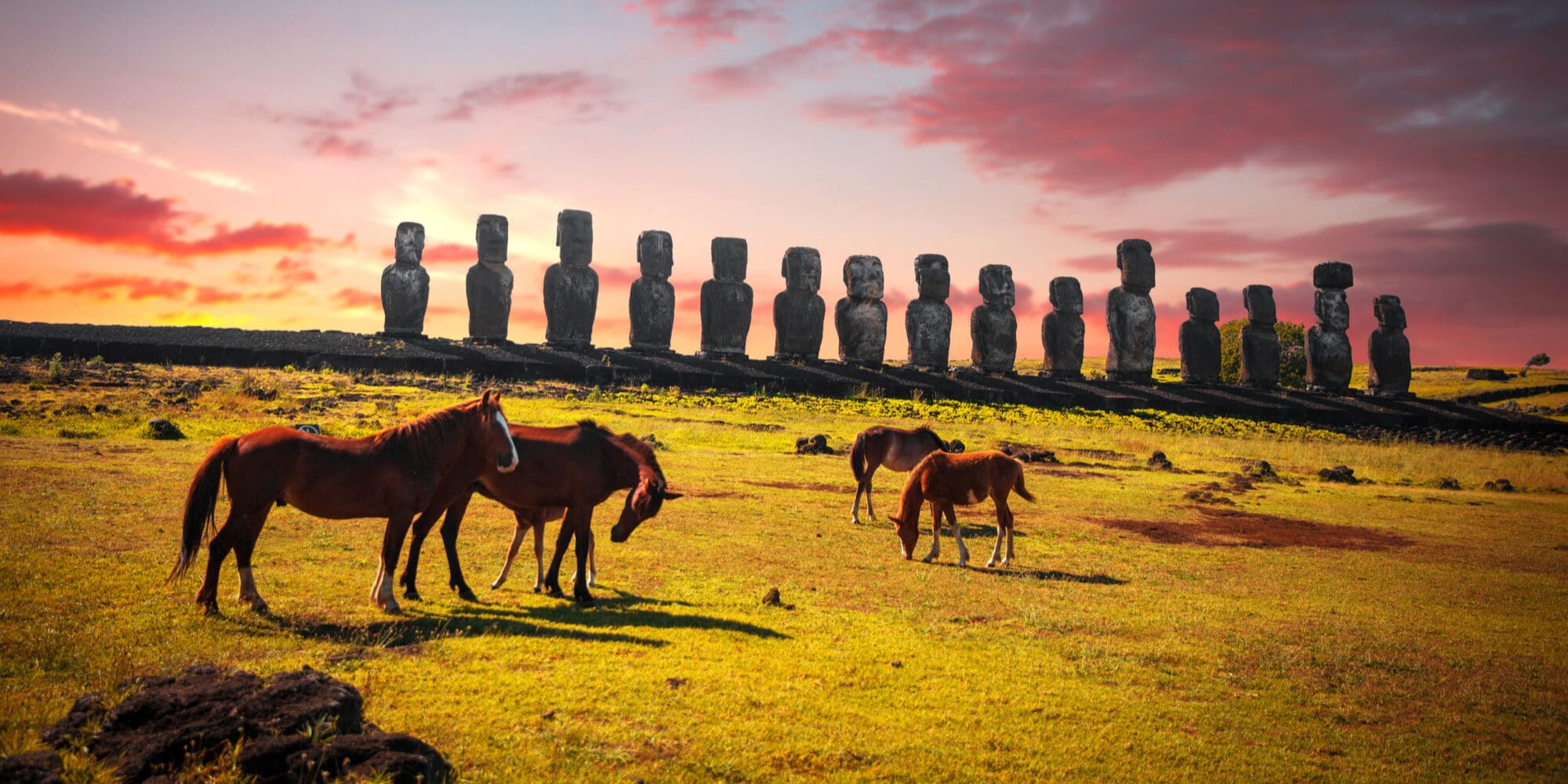](https://blog.nayararesorts.com/wildlife-conservation-in-chiles-atacama-desert-and-easter-island)
## [Wildlife Conservation in Chile's Atacama Desert and Easter Island](https://blog.nayararesorts.com/wildlife-conservation-in-chiles-atacama-desert-and-easter-island)
Mar 1, 2026
- [Nayara Gardens](https://nayaragardens.com/)
- [Nayara Springs](https://nayarasprings.com/)
- [Nayara Tented Camp](https://nayaratentedcamp.com/)
- [Nayara Alto Atacama](https://www.altoatacama.com/)
- [Nayara Hangaroa](https://www.hangaroa.cl/)
- [Nayara Bocas Del Toro](https://bocasbali.com/)
-
-
-
-
-
-
- [Costa Rica +506 2479-1600](tel:+50624791600)
- [US +1 844-865-2002](tel:+18883322961)
- [UK +44 1617918120](tel:+441617918120)
```json
{
"@context" : "https://schema.org",
"@type" : "BlogPosting",
"author" : {
"@type" : "Person",
"name" : "Albert Ghitis",
"url" : "https://blog.nayararesorts.com/author/albert-ghitis-1"
},
"dateModified" : "2026-08-02T16:44:14.907Z",
"datePublished" : "2026-03-01T04:10:31.000Z",
"headline" : "Wildlife Conservation in Arenal and Bocas del Toro",
"image" : [ "https://blog.nayararesorts.com/hubfs/Swimming-Sloth-1024x683.jpg" ],
"mainEntityOfPage" : {
"@id" : "https://blog.nayararesorts.com/wildlife-conservation-in-arenal-and-bocas-del-toro",
"@type" : "WebPage"
},
"publisher" : {
"@type" : "Organization",
"logo" : {
"@type" : "ImageObject",
"url" : "https://blog.nayararesorts.com/hubfs/Captura%20de%20pantalla%202023-04-13%20a%20la(s)%2010.55.13.png"
},
"name" : "Nayara Resorts"
}
}
```