The estimated size of the magma reservoir under this corner of the Andes, the largest known in Earth's continental crust. It heats the water at Puritama.
The year-round warmth of the Puritama pools, included in every Full Experience Program beginning August 1.
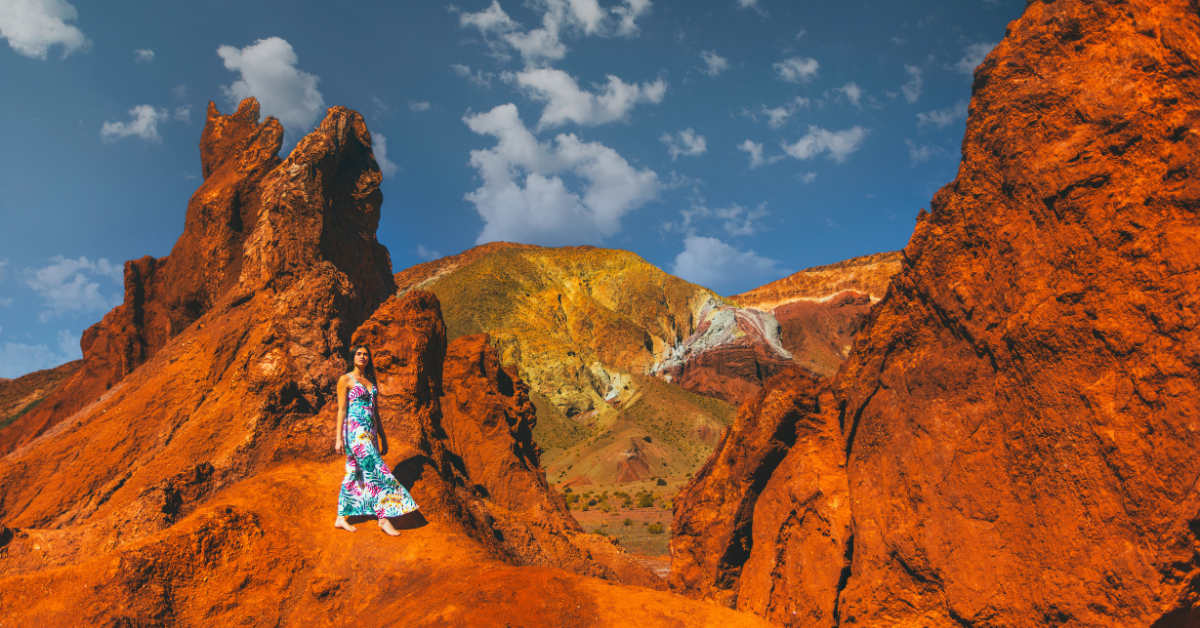
The altitude of Piedras Rojas, our newest excursion, where iron-red rock meets a turquoise lagoon on the Andean Altiplano.
Two New Doors into the Alien Landscape
In short: Beginning August 1, the Puritama Hot Springs excursion is included in every Full Experience Program at Nayara Alto Atacama, and Piedras Rojas joins our collection of desert journeys. One is a geothermal river canyon at 3,500 meters. The other is an iron-red shoreline beside a turquoise lagoon at 4,000. Both are powered by the same force: one of the largest bodies of magma ever detected in Earth's crust, working quietly beneath the driest desert on the planet.
In this chapter, we go underneath it. Two new excursions now open the desert's inner workings to our guests, and each one is a lesson in how this place was made. Puritama is what the heat under the Atacama does to water. Piedras Rojas is what time does to stone. Read them together, and you hold the whole story of the driest desert on Earth in two afternoons.
The Engine Under the Desert
The Atacama looks still. It is anything but. Offshore, the floor of the Pacific, the Nazca Plate, is diving beneath South America, and as it sinks it releases water. Water driven off the descending slab helps melt the rock above it, and that melt has been pooling under this corner of the Andes for millions of years. When geophysicists imaged the region with seismic waves, they found a body of magma and crystal mush on the order of half a million cubic kilometers, the Altiplano-Puna Magma Body, the largest known reservoir of its kind in Earth's continental crust.
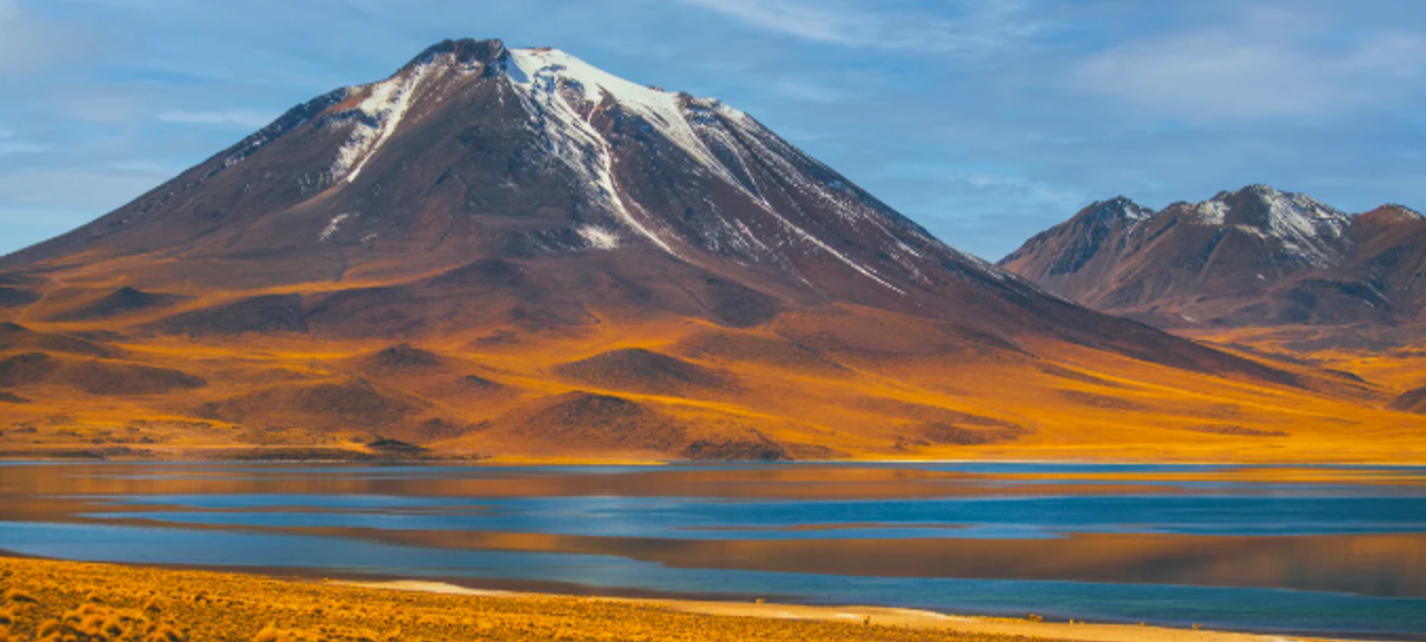
That reservoir powers everything a guest sees here. It built the volcanoes on the horizon, Licancabur among them, standing 5,916 meters over San Pedro. Its ancient eruptions laid down vast sheets of welded ash, called ignimbrite, that the desert's canyons are carved through. Its heat still rises today, boiling groundwater at El Tatio into one of the highest geyser fields on Earth and, farther south and more gently, warming a river.
That river is Puritama. The desert looks dormant. Under it, the planet is wide awake.
Puritama: The Warm River in the Canyon
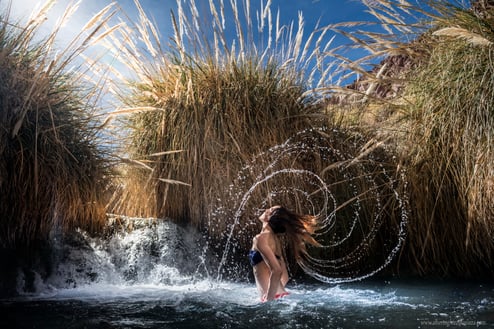
About half an hour into the hills above San Pedro, the desert does something it shouldn't. A canyon opens in the ignimbrite, and a warm river runs along its bottom. The Río Puritama emerges from the ground already heated by the volcanic system below, and at roughly 3,500 meters it steps down the canyon through a chain of clear pools, holding between 28 and 31 degrees Celsius all year in a place where nights can fall below freezing.
The water was never a secret. In Kunza, the old language of the Lickanantay people of this desert, puri means water, and these pools have been a place of bathing and healing for Atacama communities for far longer than there have been visitors to share them with. The springs are stewarded today in partnership with those communities, so that the oldest spa in the desert benefits the people who found it first.
The canyon itself is its own small climate. Sheltered from the wind and watered year-round, it grows a ribbon of giant grasses and native green through country that is otherwise bare rock. The birds of the desert concentrate here, as everything in the Atacama concentrates around water. Beginning August 1, the Puritama excursion is included in every Full Experience Program, with our guides handling the journey, timing, and towels.
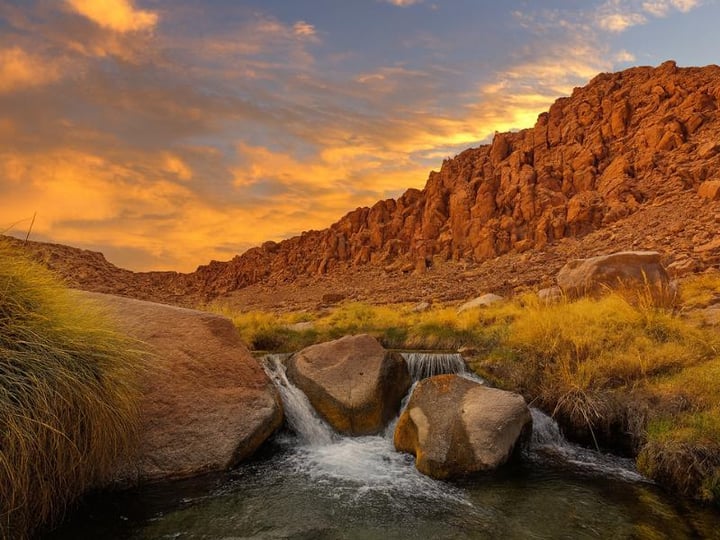
The pools of Puritama, held between 28 and 31 degrees by the volcanic system below.
What the Water Carries
Puritama's thermal water carries a distinctive mineral profile. According to the reserve, its most abundant measured minerals include magnesium, lithium, boron, sodium, and calcium. The mineral chemistry is part of the experience, but the simplest pleasure is physical: warm water, high-desert air, and time off the trail.
Research on thermal-mineral bathing suggests potential benefits for pain and physical function in some musculoskeletal conditions, although study quality varies and those findings should not be read as specific medical claims for Puritama. A 2023 systematic review found improvements across the osteoarthritis studies it reviewed while also calling for stronger clinical trials.
At altitude, after a morning on the trails, the effect is not subtle. Puritama is the desert offering back what the desert takes out of you.
Piedras Rojas: The Color of Deep Time
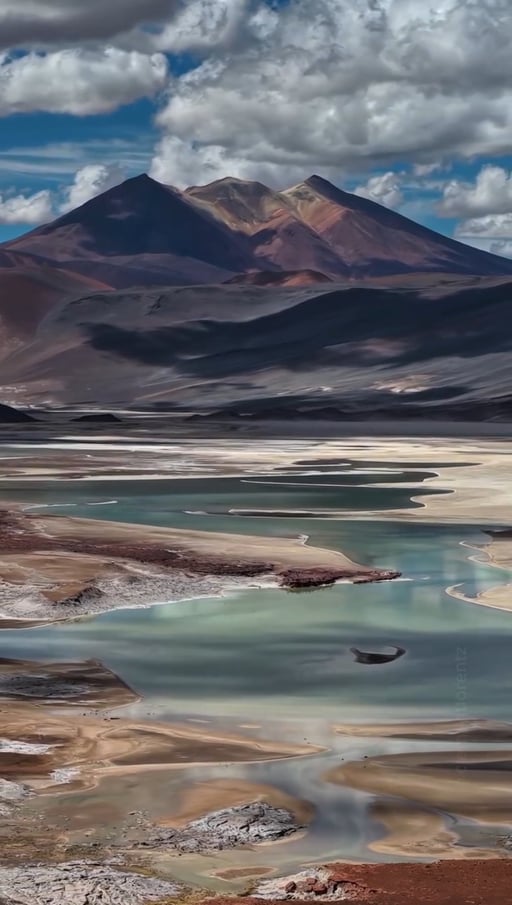
South of San Pedro, past the village of Socaire, the road climbs above 4,000 meters onto the Altiplano, the great high plateau of the Andes, second in extent only to Tibet. On the way, it passes the twin lagoons of Miscanti and Miñiques, born roughly a million years ago when lava flows sealed the basin and mountain runoff had nowhere left to go. Then the land opens onto the Salar de Aguas Calientes, and the shoreline turns the color of rust.
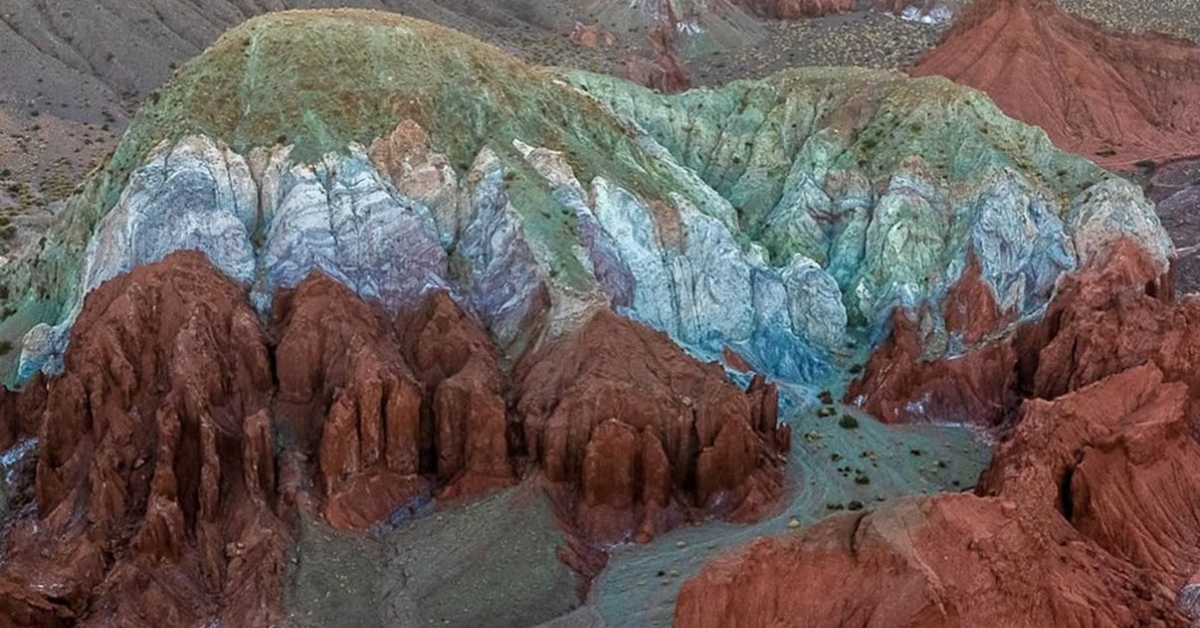
It is rust in the most literal sense. The rocks of Piedras Rojas are iron-rich volcanic stone, and over immense stretches of time the iron in them has oxidized, the same slow chemistry that reddens an old nail, painted across an entire landscape. Beside them lies a turquoise lagoon, its color shaped by dissolved minerals and the scattering of high-altitude light, and beyond that the white crust of the salt flat. Red stone, blue water, white salt, and behind it all the dark cones of the volcanoes that made everything you are standing on.
Flamingos work the lagoons of this Altiplano, three species of them, though the birds keep their own schedule and no honest guide promises them. What you can promise is the silence. At this altitude, on a windless afternoon, it is complete.
Why the Driest Desert on Earth
Both excursions owe their drama to an absence. The Atacama is the driest non-polar desert on the planet because it lacks moisture from both sides. To the east, the Andes wring out storms arriving from the Amazon. To the west, the cold Humboldt Current chills Pacific air and helps suppress rainfall, while the coastal range blocks much of the remaining moisture. Caught in that double shadow, the desert's core has remained extraordinarily dry for millions of years.
The dryness is why NASA comes here to test instruments and study planetary analogs, why northern Chile became one of the world's great centers of astronomy, and why a warm river in a green canyon feels so improbable. In the Atacama, water is not scenery. It is the whole event.
The Desert, From the Inside
A warm river in a canyon, a red shoreline at 4,000 meters, and a lodge built to disappear into the valley between them.
Albert Ghitis leads digital marketing at Nayara Resorts, overseeing editorial, email strategy, organic social, paid social, search, and AI discovery. He also hosts Nayara Horizons: Beyond Travel. Explore the latest episodes below.
Explore the Podcast
Conversations about the people, places, cultures, and ideas behind Nayara's destinations.
Frequently Asked Questions
When is the Puritama Hot Springs excursion included at Nayara Alto Atacama? +
How warm are the Puritama pools? +
Why are the rocks at Piedras Rojas red? +
How high is Piedras Rojas, and should I worry about altitude? +
What heats the water in the Atacama? +
- Nature Communications · Altiplano-Puna Magma Body
- U.S. Geological Survey · El Tatio Hydrothermal System
- Termas de Puritama · Official FAQ
- NASA Astrobiology · Atacama Research Locations
- CONAF · Reserva Nacional Los Flamencos
- Memoria Chilena · Atacameño Culture and Settlement
- PubMed · Thermal-Mineral-Water Balneotherapy Review
- U.S. Geological Survey · Salar de Atacama Geology and Groundwater