Clear nights per year in northern Chile — among the most reliable astronomical conditions on Earth.
Of people globally now live under light-polluted skies, making the Atacama's darkness increasingly irreplaceable.
Altitude of the ALMA array on the Chajnantor Plateau — air so dry it observes the coldest regions of the universe.
Why Stargazing Matters & Why It Matters Now
In short: Altitude, extreme dryness, and roughly 300 clear nights a year make the Atacama the finest stargazing on Earth — which is why the world's great observatories built here. At Nayara Alto Atacama, in the dark of the Catarpe Valley, the night sky is part of every evening. Austral winter (June through August) puts the Milky Way's galactic core directly overhead.
In most destinations, stargazing is optional. It depends on weather, timing, and luck. In the Atacama, it is intrinsic.
Artificial light has erased naturally dark skies for much of the world's population. The International Dark-Sky Association reports that more than 80 percent of people globally now live under light-polluted skies. This loss affects ecosystems, wildlife behaviour, and human circadian rhythms — not just aesthetics.
Against this backdrop, the Atacama is no longer merely exceptional. It is increasingly irreplaceable.
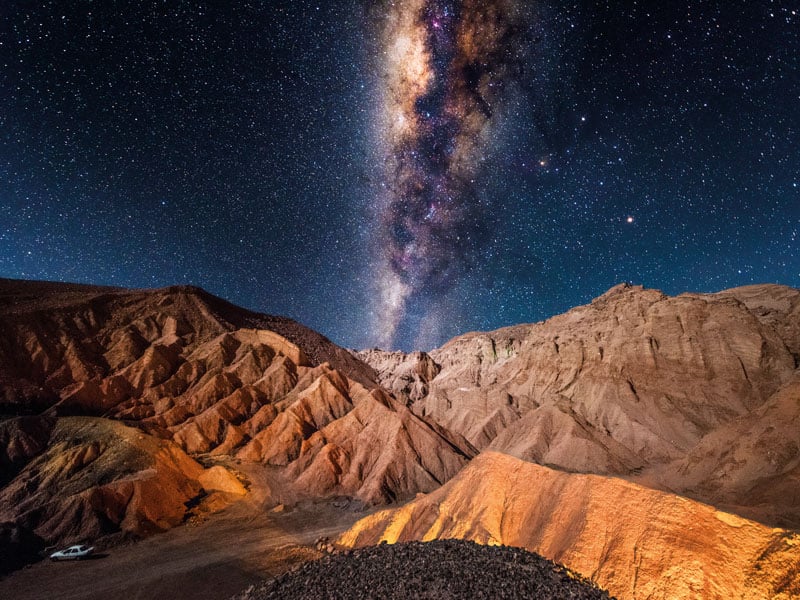
Stars appear sharp and numerous. The Milky Way emerges not as a faint haze but as a defined structure stretching across the sky — complete with visible dust lanes and dense star clouds. For many guests, this is their first experience of the night sky without filters, screens, or ambient glow flattening its depth. The effect is immediate and often humbling. Scale becomes tangible.
At Nayara Alto Atacama, this experience is framed by stillness rather than spectacle. No crowds, no competing lights, no urgency to capture the moment. The desert sets the pace. The sky rewards patience.
Why Geography Makes the Skies Unmatched
The Atacama's astronomical clarity results from precise and uncommon geographic conditions converging in a single corridor.
Much of the region sits above 2,400 metres in elevation, placing observers above a significant portion of Earth's atmosphere. Altitude reduces atmospheric turbulence, allowing starlight to reach the ground with minimal distortion.
Dryness is the second pillar. The Atacama is one of the driest non-polar places on Earth, shaped by two dominant forces: the Andes to the east create a rain shadow blocking moisture from the Amazon Basin, while the cold Humboldt Current along the Pacific coast stabilises the atmosphere and suppresses cloud formation.
Water vapour absorbs and scatters light, particularly at infrared and submillimetre wavelengths. In the Atacama, atmospheric moisture remains consistently low, allowing celestial detail to reach the surface unobstructed.
The final factor is remoteness. Northern Chile remains sparsely populated, and large tracts of land are protected from development. Artificial light sources are few and distant, preserving contrast between sky and stars.
→ Continue reading: Why the Atacama Desert Is Mars on Earth
Why Astronomers Came Here First
Long before stargazing became a defining travel experience, scientists recognised the Atacama's value. Decades of site testing confirmed northern Chile as the most reliable location on Earth for astronomical research.
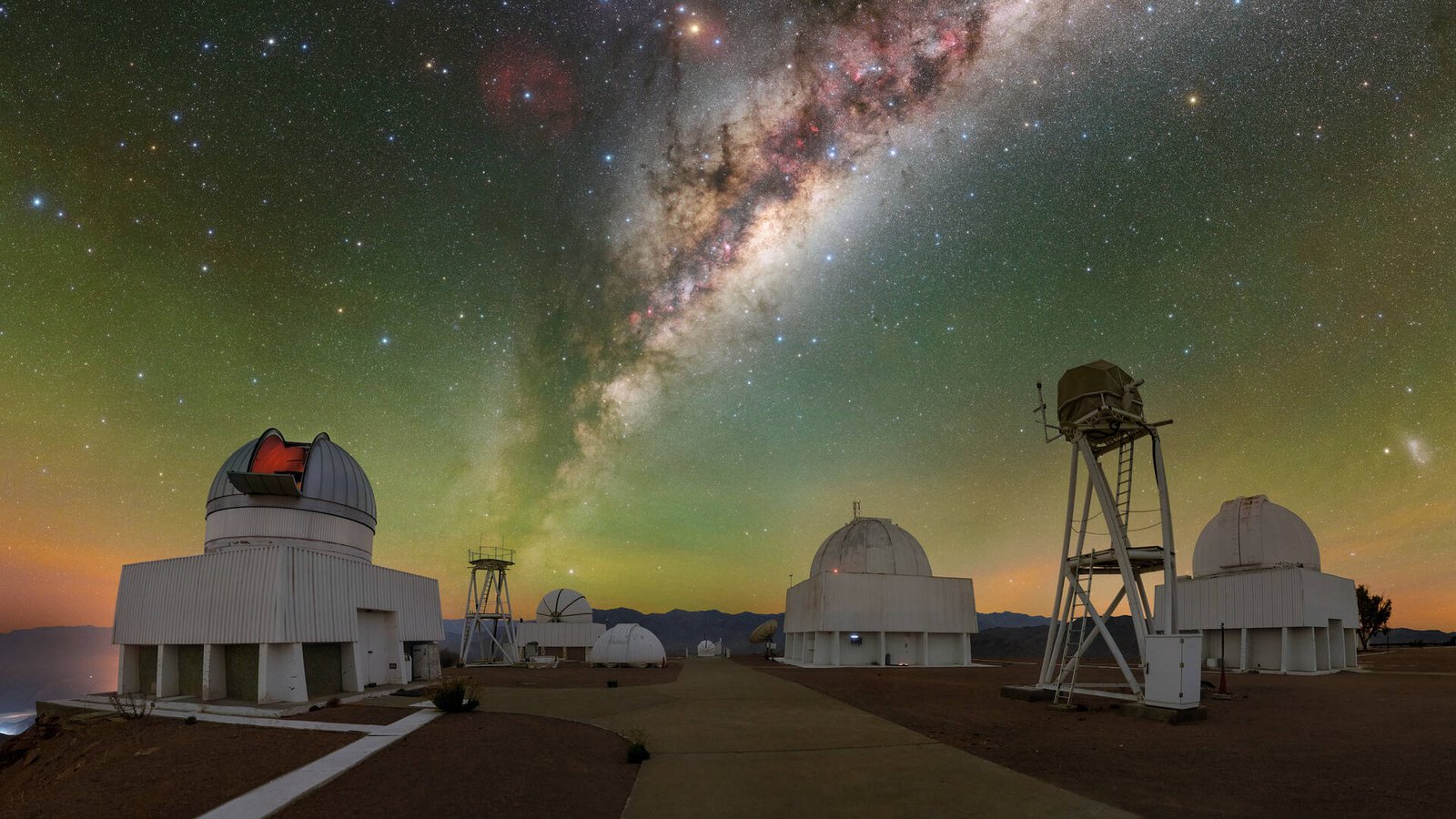
The ALMA Observatory — the Atacama Large Millimeter/submillimeter Array — sits at 5,000 metres on the Chajnantor Plateau. Its 66 antennas work in concert to observe molecular gas, dust formation, and the earliest structures of the universe in wavelengths invisible to the human eye.
The European Southern Observatory operates the Paranal Observatory nearby, home to the Very Large Telescope — one of the most productive optical observatories in the world. Its instruments have contributed to discoveries ranging from exoplanets to the behaviour of supermassive black holes.
The historic La Silla Observatory reinforces the same conclusion. Decades of continuous observation confirm that the Atacama offers reliability and clarity unmatched by nearly any other region on Earth.
For guests at Nayara Alto Atacama, these observatories are quiet confirmation that the sky overhead is among the finest on the planet.
What the Atacama's Skies Reveal
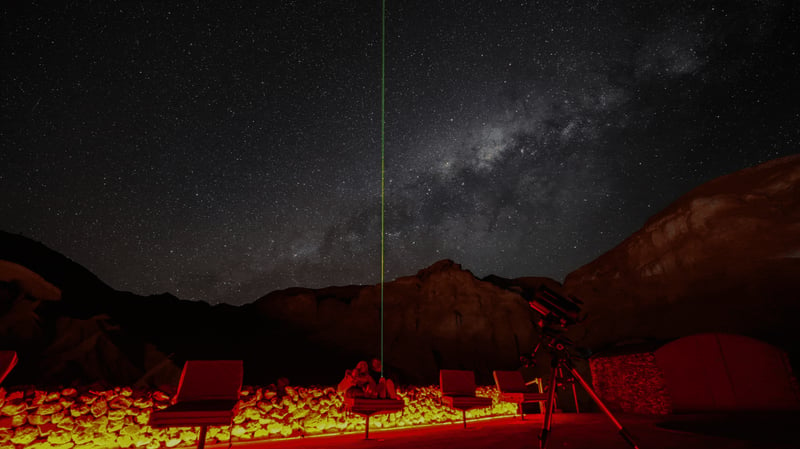
On moonless nights, the Milky Way's dense core appears as a luminous band arching overhead, with dark dust lanes clearly separating star-rich regions. This level of structure is rarely visible outside a handful of locations worldwide.
Because the Atacama lies in the southern hemisphere, guests encounter constellations unfamiliar to many travellers from the north. The Southern Cross, Centaurus, and Carina dominate the sky, alongside dense star fields near the galactic centre.
Planetary observation is equally compelling. Jupiter's moons and Saturn's rings are visible through telescopes at modest magnification. During favourable alignments, Mars and Venus reveal surface or phase detail. Deep-sky objects — globular clusters, emission nebulae — appear with striking clarity.
How Andean Cultures Read the Sky
Long before observatories arrived, the sky already carried meaning here.
For Indigenous Andean societies, including the Atacameño people, the night sky was a living system connecting land, water, animals, and time. Unlike Western astronomy, which maps constellations by connecting stars, Andean sky knowledge focused on the dark spaces within the Milky Way.
These "dark constellations" are formed by dust lanes visible only under extremely dark skies. The tradition is documented by the American Museum of Natural History, which explains their role in agriculture and seasonal planning.
The Milky Way itself was understood as a celestial river, reflecting rivers and water systems on Earth. Research summarised by the Smithsonian National Museum of the American Indian shows how its movement anticipated rainfall, snowmelt, and fertility.
Animals — the celestial llama, fox, and snake — were identified in the Milky Way's dark regions. According to the University of Texas McDonald Observatory, these figures guided herding cycles and ecological awareness.
When and How to Experience Stargazing in the Atacama
Stargazing at Nayara Alto Atacama is possible year-round, but the sky itself changes with the seasons.
The austral winter — June through August — is the sky's finest season. The Milky Way's galactic core rises earlier and stays visible longer, atmospheric turbulence drops, and cloud cover all but disappears. Other seasons reveal different constellations and planetary alignments, each with its own character.
Moon phase plays a decisive role. Around the new moon, the sky reaches its darkest state, revealing faint stars, nebulae, and the Milky Way's full structure. At other times, moonlight reshapes the experience, emphasising planets and brighter star fields.
Temperature and altitude influence comfort rather than clarity. Stargazing here is unhurried and contemplative — warmth allows the experience to unfold fully. In most places, darkness has been erased by light and speed. In the Atacama in winter, night returns as a place.
Where the Night Still Belongs to the Sky
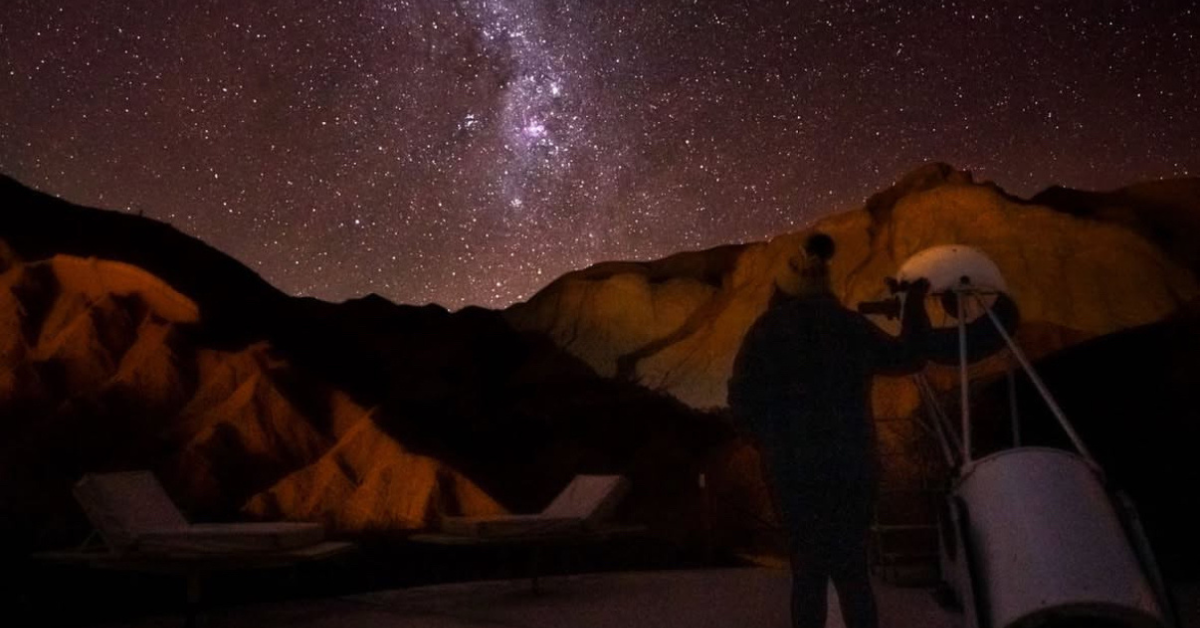
In much of the world, the night sky has become an abstraction — filtered by light, speed, and distraction. In the Atacama, it remains intact.
The same conditions that draw astronomers from across the globe allow guests to encounter the universe directly, without mediation or interference. Stargazing here is not framed as novelty. It is a return to scale.
The desert's silence, the sky's clarity, and the passage of time combine to create an experience that is both grounding and expansive. Perspective comes not from explanation alone, but from presence.
To stand beneath these skies is to understand why the Atacama has mattered for so long — and why it matters now. In a world growing brighter and faster, places where darkness still exists are becoming increasingly rare. At Nayara Alto Atacama, the night remains vast, legible, and patient.
At Nayara Alto Atacama, the night sky is not an amenity.
It is the landscape itself.
Can I see the Milky Way without a telescope?
Are stargazing experiences guided or self-led?
Does altitude affect the stargazing experience?
What should I wear for nighttime stargazing?
Is stargazing available year-round?
What is the best moon phase for stargazing?
Astronomy and Atmospheric Science
- European Southern Observatory: Astronomy in Chile
- ALMA Observatory: Site Conditions
- ESO Paranal Observatory
- ESO La Silla Observatory
- International Dark-Sky Association
Indigenous Sky Knowledge
Stand beneath the clearest skies on Earth
Nayara Alto Atacama sits in the Catarpe Valley, under one of the darkest, clearest night skies anywhere.
The Atacama Collection
Six stories from the driest desert on Earth.
01 On the Edge of Subsistence → 02 Why the Atacama Is Mars on Earth →